 Milesheet
Why sorting trips is a card deck and not a list
The design decision that determines whether anyone actually keeps a mileage log.

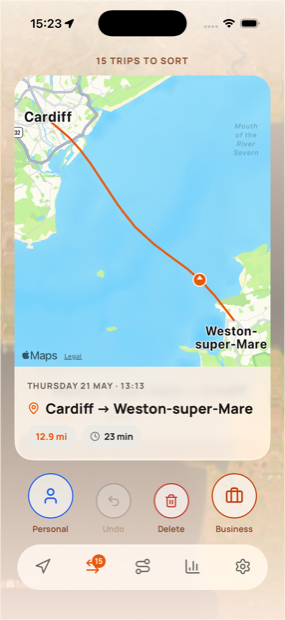
Recording drives is the easy half of a mileage app. Any phone can do it. The half that decides whether anyone still uses the thing in March is deciding which drives were work.
Why lists fail
Most mileage apps present the backlog as a list with a dropdown on each row. It is a perfectly logical design and almost nobody finishes it.
The reasons are consistent. A list shows how much is left, which is discouraging. Each row demands a decision without giving you enough to make it — a date and a distance do not tell you what a journey was. And the interaction is precise: find the row, hit the small control, choose from a menu, move on. Precision is fine at a desk and awful on a sofa.
Why a deck works
One journey at a time, with its route drawn on a map, and a gesture rather than a target.
- The map is the memory aid. People do not remember 14 August. They remember the shape of a drive to Bristol and back.
- One card is not a backlog. You cannot see how many are left, so you do not stop because it looked like a lot.
- A swipe is imprecise on purpose. It works one-handed, on a sofa, while something else is on.
- It is reversible. Every swipe has an undo, so being wrong costs nothing and you stop hesitating.
The measure of success is that a week of driving takes under a minute. Below that threshold people do it. Above it, they intend to.
Why the list loses
| List with dropdowns | Card deck | |
|---|---|---|
| Shows how much is left | Yes — discouraging | No |
| Memory aid per item | Date and distance | The route on a map |
| Interaction | Precise tap on a small control | A swipe |
| One-handed on a sofa | Awkward | Yes |
| Undo | Sometimes | Every action |
| Time for a week of driving | Several minutes | Under a minute |
The last row is the only one that matters. Below a minute people do it; above it they intend to.
What makes it faster still
Tagged places. Once the office and your regular sites are tagged, most cards arrive with the answer suggested and an Auto-sort button clears them together.
Bulk selection, for when a fortnight away has left a genuine pile: hold one trip, tick the rest, file them all at once.
Commuting excluded automatically, once home and workplace are tagged, so the journeys that were never claimable stop occupying your attention.
The unglamorous point
None of this is clever technology. It is the recognition that the hard part of a mileage log is not measurement, it is the two seconds of human judgement per journey — and that the whole thing lives or dies on making those two seconds cheap enough that they happen.