 Milesheet
Five habits that turn a mileage app into a claim
Installing it is not the job. These are the small things that decide whether you have a record worth filing in January.

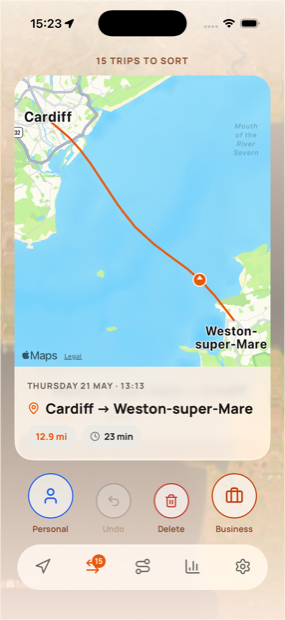
Most abandoned mileage logs are not abandoned because the app was bad. They are abandoned because the habit never formed. These five take about two minutes a week between them.
1. Sort trips while you still remember them
The single highest-value habit. A journey sorted on the evening it happened is accurate. The same journey sorted in April is a guess dressed as a record.
Milesheet's Classify deck exists for this: each card replays the route on a map, you swipe right for business and left for personal, and a week of driving takes under a minute. Do it while the kettle boils.
2. Tag your regular places once
Ten minutes, once, and a large proportion of your sorting stops being manual. Tag the office, the sites you visit repeatedly, the clients you see monthly.
Tag your house as Home and any permanent workplace as Workplace while you are there. That is what keeps ordinary commuting out of your claim, which is the most common way a mileage claim goes wrong.
3. Log the fill-up at the pump, not later
Two full tanks with odometer readings and Milesheet knows your car's real economy rather than the brochure figure. Every trip cost after that is a real number.
The reason to do it at the pump is that the odometer reading is the part you cannot reconstruct afterwards. The receipt survives; the mileage on the dash does not.
4. Check Insights once a month
Not for pleasure — for the two things that are much harder to fix later. Whether anything is still unclassified, and whether the unlogged mileage figure has appeared, which means the odometer and your journeys disagree and some driving never got recorded.
A month-old gap is recoverable from memory and a calendar. A year-old one is not.
5. Export at the end of the tax year, not the end of January
Produce the CSV and the claim PDF in April while the year is fresh, and put them somewhere that is not only your phone. If you file in January, you want the version you assembled when you could still check it.
Turn on auto-export and even this one takes care of itself.
The habits, and what each is worth
| Habit | How often | Time | What it protects |
|---|---|---|---|
| Sort trips while you remember them | Weekly | 1 min | Accuracy of the whole log |
| Tag your regular places | Once | 10 min | Most future sorting, and commuting exclusion |
| Log the fill-up at the pump | Per fill | 30 sec | Real MPG, and the odometer trail |
| Check Insights | Monthly | 2 min | Unclassified backlog and unlogged mileage |
| Export at tax year end | Yearly | 2 min | The version you filed from |
Under fifteen minutes a year of actual effort, plus a minute a week.
The underlying point
None of these are about diligence. They are about doing the small thing at the moment it is easy, so that nothing depends on remembering anything nine months later.