 Milesheet
Getting a year of driving into Milesheet after the fact
You started in October and the tax year began in April. Here is how to make the first half of the year count.

Almost nobody starts recording on 6 April. Most people start when something prompts them — a tax bill, an accountant's email, a realisation that a year of driving went unrecorded. The half-year behind you is still worth recovering.
If you have a CSV from another app
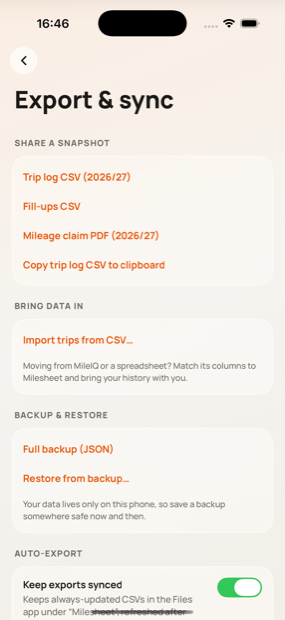
The quickest route. Export from the old app, then Settings → Export & sync → Import trips from CSV.
Milesheet reads most formats because you map the columns yourself: which one is the date, which is the distance, which are the start and end places. Only date and distance are required. Duplicates of trips you already have are skipped, so importing twice does not double your mileage.
Check two things afterwards:
- Units. If the old app exported kilometres and you told Milesheet miles, everything is 60% too small and the claim with it.
- Classification. Some exports carry business/personal, some do not. If not, everything lands unclassified and you sort it in the Classify deck.
If you have a spreadsheet
Same route. Save it as CSV, map the columns. A spreadsheet with dates, distances and a note of where you went imports as well as any app export.
If you have nothing but a diary and a bank statement
Harder, and worth being honest about: what you can reconstruct is not as strong as a contemporaneous record. But it is far better than nothing, and there are more anchors than people realise.
- Your calendar gives dates and destinations for meetings
- Invoices tell you which client you visited and when
- Fuel receipts put you at a place on a date, and the odometer readings between them tell you how far the car actually went
- Odometer readings at MOT are recorded and give you a total for the year
Add the journeys you can evidence by hand — Trips → + — and leave out the ones you genuinely cannot. A shorter honest log beats a longer invented one, and a reconstructed claim that agrees with your invoices and fuel receipts is defensible in a way that a round number is not.
What each source can give you
| Source | Gives you | Strength |
|---|---|---|
| CSV from another app | Dates, distances, often places | Strongest — contemporaneous |
| Spreadsheet you kept | Whatever you recorded | Strong if kept as you went |
| Calendar | Dates and destinations of meetings | Good corroboration |
| Invoices | Which client, which week | Good corroboration |
| Fuel receipts | Where you were, when | Places you at a location on a date |
| Odometer at MOT | Total miles for the year | Bounds the whole reconstruction |
| Memory alone | Very little | Weakest — avoid relying on it |
A reconstruction that agrees with three of these is defensible. One built only from the last row is not, and is better left out.
Then close the gap for good
Once the history is in, turn on departure detection so the recording stops depending on you remembering. The reason to do this today rather than in April is that this is the exact situation you are trying not to repeat.