 Milesheet
Claiming mileage as a company director
Your own car, your own company, and the paperwork that keeps 45p a mile out of the taxman's definition of salary.


Update, April 2026: the approved rate for cars and vans rose from 45p to 55p a mile for the first 10,000 business miles. The 25p rate above that, and the 5p passenger payment, are unchanged. This post describes the position as it stood when it was written.
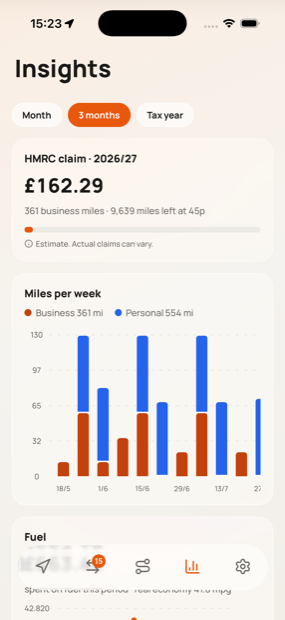
If you run a limited company and drive your own car on its business, the company can pay you the approved mileage rates, 45p a mile for the first 10,000 business miles in the tax year, then 25p, and that payment is tax-free in your hands and deductible for the company.
It is one of the more efficient ways to take money out of a company. It is also one of the easiest to do sloppily.
You are an employee here
A director is an office holder, and for these purposes the same rules apply as to any employee. The car is yours, the company reimburses you for business journeys, and the approved rates are what it can pay without creating a tax charge.
Pay more than the approved rate and the excess is earnings, reportable and taxable. Pay less and you can claim relief on the shortfall personally, exactly as an employee would.
What it is worth to take mileage rather than salary
Paying yourself £4,500 of approved mileage instead of the equivalent gross salary:
| Via salary | Via approved mileage | |
|---|---|---|
| Cost to the company | £4,500 + employer NIC | £4,500 |
| Income tax on you | Yes, at your marginal rate | None |
| Employee NIC | Yes | None |
| Corporation tax deduction for the company | Yes | Yes |
| Paperwork required | Payroll | A mileage log |
That is why it is efficient, and equally why the log matters: the whole benefit rests on the payment being a reimbursement of a real cost rather than disguised remuneration.
The record is the whole thing
Because you are both sides of this transaction, nobody else is checking your figures, which is precisely why the record needs to stand on its own.
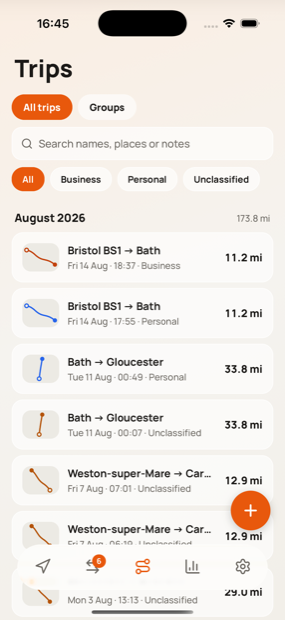
What is expected is a journey-level log: date, from, to, purpose, distance. A monthly transfer from the company account described as "mileage" with no underlying detail is not a record, it is a payment. If the detail is missing, the payment starts to look like undeclared salary, and that is an expensive reclassification.
Commuting is still commuting
Owning the company does not change the rule. Travel from home to your permanent workplace is ordinary commuting whether the workplace belongs to your employer or to you.
If you genuinely work from home and the company has no other premises, the position is different, but "the company is registered at my house" does not by itself make every drive claimable. This is worth getting right, because it applies to a lot of journeys repeated a lot of times.
Company car versus your own
If instead the company buys the car, none of the above applies: the vehicle is a benefit in kind with its own charge, and fuel is handled through Advisory Fuel Rates rather than approved mileage rates. Which is better depends on the car's value, its emissions and your mileage, and it is one of the few genuinely worthwhile conversations to have with an accountant.
Keeping it simple
Record every journey as it happens, mark it business or personal, tag home and any permanent workplace so commuting is excluded automatically, and export the year as a CSV. Then the mileage the company paid you and the mileage you can evidence are the same number, which is the whole point.
Sources
- Business travel mileage for employees' own vehicles (HMRC)
- Travel, mileage and fuel rates and allowances (HMRC)
- Advisory fuel rates (HMRC)
- 490: Employee travel, a tax and NICs guide (HMRC)
General information, not tax advice. Director remuneration has knock-on effects: take proper advice on the whole picture.