 Milesheet
HMRC mileage rates explained: 55p, 25p and the 10,000-mile line
What the approved mileage rates actually are, how the 10,000-mile threshold works across a tax year, and the bit almost everyone gets wrong.

If you use your own car for work, HMRC lets you be paid a set amount per mile without any of it counting as taxable pay. These are the Approved Mileage Allowance Payments, and they have not changed since 2011.
The car and van rate rose to 55p on 6 April 2026, the first change since 2011. Anything you read quoting 45p was written before that.
The rates
| Vehicle | First 10,000 business miles | Above 10,000 | Banded? |
|---|---|---|---|
| Cars and vans | 55p per mile | 25p per mile | Yes |
| Motorcycles | 24p per mile | 24p per mile | No |
| Bicycles | 20p per mile | 20p per mile | No |
| Each passenger carried | 5p per mile | 5p per mile | No |
There is also a passenger rate: 5p per mile for each colleague you carry on the same business journey. It is one of the most commonly missed parts of a claim, partly because you have to be able to say who was in the car and where you went.
The 10,000-mile line is per tax year, not per car
This is where people slip up. The threshold resets on 6 April each year, and it counts all your business miles across every car and van you use, not each vehicle separately. Two cars doing 6,000 business miles each is 12,000 miles: the first 10,000 at 45p, the last 2,000 at 25p.
The other subtlety: a single journey can straddle the line. If you hit 10,000 miles halfway through a 40-mile drive, the first 20 miles are worth 55p and the rest 25p. Any log worth keeping should split that trip rather than round the whole thing one way or the other.
What if your employer pays less than 55p?
Very common, and worth money. If your employer pays you 25p a mile, you can claim tax relief on the difference between what you were paid and the approved rate. That is Mileage Allowance Relief, and you claim it through your Self Assessment return or a P87 if you do not file one.
Say you drove 4,000 business miles and were paid 25p:
- Approved amount: 4,000 × 55p = £2,200
- Actually paid: 4,000 × 25p = £1,000
- Relief due on: £1,200
You do not get £1,200 back. You get tax relief on £1,200, so a basic-rate taxpayer sees around £240. Still worth the ten minutes it takes to claim, and considerably more if your mileage is higher.
If your employer pays you more than the approved rate, the excess is taxable and should appear on your P11D.
What a year is worth, by mileage
Assuming the car rate and no employer reimbursement:
| Business miles | At 55p | At 25p | Total allowance | Blended rate |
|---|---|---|---|---|
| 2,000 | £1,100 | n/a | £1,100 | 55.0p |
| 5,000 | £2,750 | n/a | £2,750 | 55.0p |
| 10,000 | £5,500 | n/a | £5,500 | 55.0p |
| 15,000 | £5,500 | £1,250 | £6,750 | 45.0p |
| 20,000 | £5,500 | £2,500 | £8,000 | 40.0p |
| 30,000 | £5,500 | £5,000 | £10,500 | 35.0p |
The blended rate is the column worth looking at. The more you drive, the less each mile is worth on average, which is the opposite of how most people assume it works, and it matters when deciding between a company car and your own.
What relief is actually worth to you
Relief is not a refund. It reduces your taxable income, so what you receive depends on your rate:
| Shortfall claimed | Basic rate (20%) | Higher rate (40%) | Additional rate (45%) |
|---|---|---|---|
| £200 | £40 | £80 | £90 |
| £1,200 | £240 | £480 | £540 |
| £2,200 | £440 | £880 | £990 |
| £5,500 | £1,100 | £2,200 | £2,475 |
If you drive a company car, these rates are not yours
Approved mileage rates apply to your own vehicle. If the car belongs to the company, fuel is handled through Advisory Fuel Rates instead, which are lower, vary by engine size and fuel type, and are revised quarterly. Mixing the two up is the single most expensive mistake we see people make on a claim.
What different employer rates leave on the table
On 6,000 business miles in a tax year, where the approved amount is £3,300:
| Employer pays | You receive | Shortfall | Relief at 20% | Relief at 40% |
|---|---|---|---|---|
| 55p (the approved rate) | £3,300 | £0 | n/a | n/a |
| 45p (the old approved rate) | £2,700 | £600 | £120 | £240 |
| 30p | £1,800 | £1,500 | £300 | £600 |
| 25p | £1,500 | £1,800 | £360 | £720 |
| Nothing | £0 | £3,300 | £660 | £1,320 |
You can generally claim for the current tax year and the previous four, so someone who has never claimed and is paid 25p on this mileage is looking at four figures.
What actually needs recording
For each business journey: the date, where you went and where from, why it was business, and how far it was. Keep the running total for the tax year so the banding is right, and hold on to the records for at least 22 months after the end of the tax year if you are employed, or five years after the filing deadline if you are self-employed.
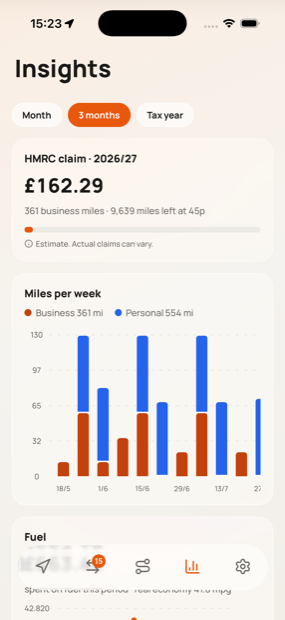
That is precisely the job Milesheet does in the background: it records the journey as you drive, bands each trip against your running total for the year, and keeps the whole lot exportable as a PDF or CSV.
Sources
- Travel, mileage and fuel rates and allowances (HMRC)
- Business travel mileage for employees' own vehicles (HMRC)
- Claim tax relief for your job expenses: vehicles you use for work (HMRC)
- Claim Income Tax relief for employment expenses (P87) (HMRC)
- Advisory fuel rates (company cars) (HMRC)
- Self Assessment: keeping your records (HMRC)
Rates and thresholds are correct at the time of writing and apply to the UK. This is general information, not tax advice: check with HMRC or your accountant before you file.