 Milesheet
How to keep a mileage log that stands up
What HMRC expects a mileage record to contain, how long to keep it, and why the spreadsheet you fill in every April is the weakest version of it.

A mileage claim is only as good as the record behind it. If someone asks you to justify 8,400 business miles two years after the fact, you want a log that answers the question rather than a number you once believed.
What a record should contain
For every business journey:
- The date it happened
- Where you started and where you finished
- Why it was business, in enough words to jog a memory
- How far you went
- Which vehicle you used, if you have more than one
Add a running total for the tax year and you can prove the 55p and 25p banding is right, which is the part reconstructed logs almost always get wrong.
How long to keep it
- Employees claiming Mileage Allowance Relief: at least 22 months after the end of the tax year the claim relates to.
- Self-employed: at least five years after the 31 January filing deadline for that tax year.
Keep the record in a form you can still open. A note on a phone you no longer own is not a record.
Why the April spreadsheet is the weak version
Three things go wrong when you write it all up at the end of the year.
Memory. You remember the big trips and forget the twenty-mile round trip to a supplier in October. Those are the miles you paid for and never claimed.
Distance. Postcode-to-postcode estimates are not the same as the route you drove. Sometimes that is in your favour, sometimes it is not, and either way it is not evidence.
Banding. Fill in the mileage in one lump and the 10,000-mile threshold gets applied to the total rather than to journeys in date order. If your driving is at all seasonal, that number is wrong.
The habit that fixes it
Record as you go, and sort promptly. Anything that captures the drive at the time, an app, a notebook in the glovebox, a note dictated at the traffic lights, beats a perfect spreadsheet built from memory.
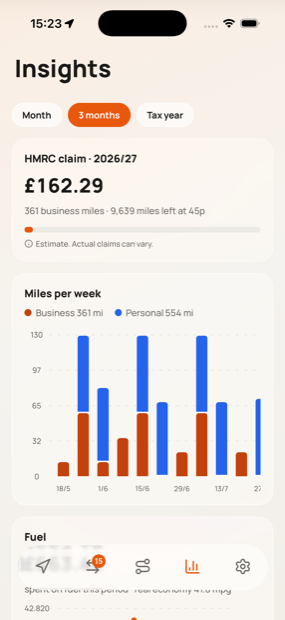
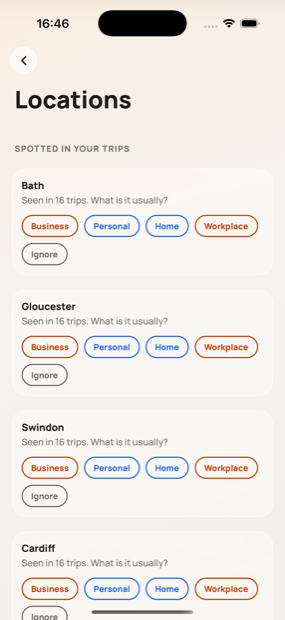
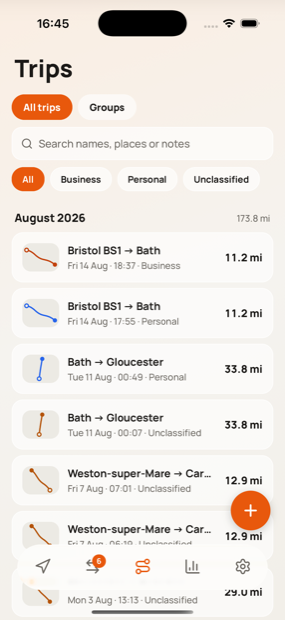
If you use Milesheet, this is the whole design: the journey is recorded while it happens, and the only question left is business or personal. It bands each trip against your running total for the tax year, keeps a per-trip and per-month record, and exports the lot as a PDF or CSV that reads like something you could hand to an accountant, because that is what it is for.
A quick self-test
Pick a random week from three months ago. Can you say, without guessing:
- Which drives you made for work?
- Where each one started and ended?
- How far each one was?
- Why it was business?
If the answer is no, your log is not a log yet. That is entirely fixable, and the fix takes about ten seconds a day.
What a record must contain
| Field | Required? | Example | What it proves |
|---|---|---|---|
| Date | Yes | 14 Aug 2026 | Ties to calendar, invoices, fuel receipts |
| Start location | Yes | Home | Establishes commuting or not |
| Destination | Yes | Acme Ltd, Harrogate | The workplace, not just a town |
| Purpose | Yes | Site survey | The business character |
| Distance | Yes | 18.4 mi | The claim itself |
| Vehicle | If more than one | Van, AB26 CDE | Keeps totals apart |
| Route | Helpful | Recorded | Answers "why so far?" |
| Running total | Helpful | 4,210 mi YTD | Gets the banding right |
How long to keep it
| If you are | Keep records until |
|---|---|
| Employed | At least 22 months after the end of the tax year |
| Self-employed | At least 5 years after the 31 January filing deadline |
| Running a company | Generally 6 years from the end of the accounting period |
Strong record versus weak record
| Weak | Strong |
|---|---|
| "August: 340 business miles" | 22 individual journeys totalling 341.6 miles |
| Round numbers throughout | Distances that are obviously measured |
| Written up in April from memory | Recorded on the day |
| No purpose recorded | Client or job named on each trip |
| Commuting included | Home-to-workplace excluded and visibly so |
| One total across two vehicles | Each vehicle separately |
Sources
- Self Assessment: keeping your records (HMRC)
- Travel, mileage and fuel rates and allowances (HMRC)
- 490: Employee travel, a tax and NICs guide (HMRC)
- Expenses if you're self-employed: vehicles (HMRC)
General information for UK drivers, not tax advice.