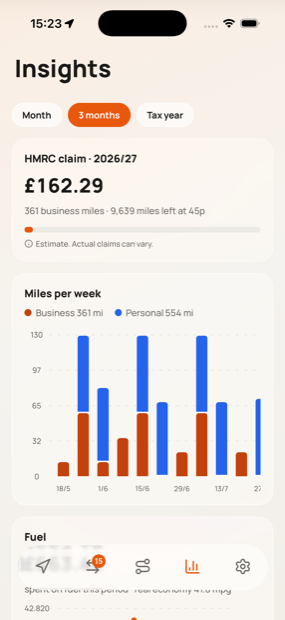
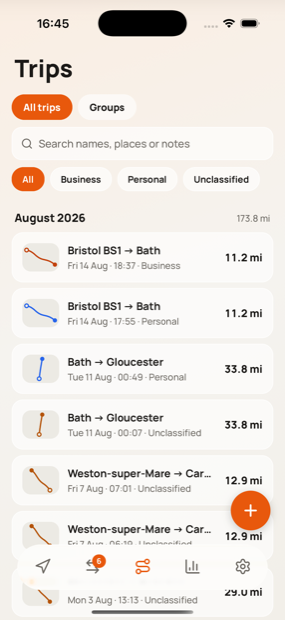
 Milesheet
Company car or your own: what you can actually claim
Advisory Fuel Rates, approved mileage rates, and the expensive habit of confusing the two.


There are two entirely separate systems here, they use different numbers, and mixing them up is the most expensive routine mistake on UK mileage claims.
If the car is yours
You use Approved Mileage Allowance Payments: 55p a mile for the first 10,000 business miles in the tax year, 25p thereafter. That rate is meant to cover everything the car costs you. Fuel, insurance, servicing, depreciation, the lot.
If your employer pays you less than that, you can claim tax relief on the shortfall. If they pay more, the excess is taxable.
If the car belongs to the company
Approved mileage rates do not apply. The company already owns the car and bears its costs, so there is nothing to reimburse you for except fuel. That is what Advisory Fuel Rates are for.
Advisory Fuel Rates are:
- Much lower: pence per mile figures that vary by engine size and fuel type
- Revised quarterly, so last year's figure is not this year's
- Used both for reimbursing employees for business fuel, and for employees repaying the cost of private fuel
The practical consequence: someone with a company car claiming 55p a mile is claiming something they are not entitled to, usually without realising, and often for years.
Which system applies
| Situation | Rate system | Roughly |
|---|---|---|
| Your own car, business journey | Approved mileage rates | 55p then 25p |
| Your own EV, business journey | Approved mileage rates | 55p then 25p |
| Company car, business fuel | Advisory Fuel Rates | Pence per mile, by engine and fuel |
| Company EV, business mileage | Advisory electricity rate | A single pence-per-mile figure |
| Company car, private fuel paid by employer | Car fuel benefit | Fixed charge from CO2, not usage |
Advisory rates are revised quarterly. Approved mileage rates have not changed since 2011.
The size of the error
Someone with a company car claiming the approved car rate instead of the advisory fuel rate, on 10,000 business miles:
| Per mile | 10,000 miles | |
|---|---|---|
| Claimed at 55p | 55p | £5,500 |
| Advisory fuel rate (illustrative) | ~14p | £1,400 |
| Over-claimed | ~£3,100 |
Repeated across several years, that is the kind of error that gets expensive with interest attached. The advisory figure varies by engine size and fuel type. Check the current table rather than using the number above.
Electric company cars
There is a separate advisory electricity rate for fully electric company cars, published alongside the fuel rates and revised on the same cycle. It is not the same as the 55p rate, for the same reason: the company owns the car.
An electric car that is yours is different again. Approved mileage rates apply at the normal 55p and 25p, regardless of the fact you are charging rather than filling up.
Why the record still matters
Under both systems the underlying evidence is identical: which journeys were business, when, where from and to, and how far.
The difference is only in what you multiply the miles by. Get the log right and switching between the two, a new job, a company car arriving or going away, is a change of rate rather than a change of habit.
Milesheet keeps each vehicle separate, with its own economy and running costs, so a company car and your own car do not end up in the same total.
Sources
- Advisory fuel rates (HMRC)
- Travel, mileage and fuel rates and allowances (HMRC)
- Business travel mileage for employees' own vehicles (HMRC)
General information for UK drivers, not tax advice. Advisory Fuel Rates change quarterly. Check the current table before you claim.