 Milesheet
Claiming mileage in a van
Vans use the same 45p rate as cars, which is better news for some trades than others, and worse news than actual costs for a few.


Update, April 2026: the approved rate for cars and vans rose from 45p to 55p a mile for the first 10,000 business miles. The 25p rate above that, and the 5p passenger payment, are unchanged. This post describes the position as it stood when it was written.
Vans sit in the same band as cars for approved mileage: 45p a mile for the first 10,000 business miles, 25p after. There is no separate van rate, which is the first thing worth knowing and the reason the mileage rate suits some trades badly.
Why the flat rate can work against a van
The 45p figure is built around the running costs of an average car. A van is generally not an average car. It is heavier, thirstier, harder on tyres and brakes, more expensive to insure commercially, and often working considerably harder than a family hatchback.
If you are running a long-wheelbase van at 28 mpg, loaded, doing 6,000 business miles a year, the flat rate may well be less than the vehicle genuinely costs you. That is the case where actual costs deserve a proper look. Real fuel, real servicing, real insurance, plus capital allowances on the purchase.
Against that: actual costs mean keeping every receipt and defending a business-use percentage.
When the flat rate stops covering a van
Approved rate against real running cost per mile:
| Vehicle | Real cost/mile | 45p covers it? |
|---|---|---|
| Small van, 45 mpg, bought used | ~28p | Comfortably |
| Mid van, 38 mpg, 3 years old | ~36p | Yes, with margin |
| LWB van, 30 mpg, loaded, new | ~48p | No |
| LWB van, 28 mpg, high mileage, towing | ~55p | No |
The bottom two rows are where actual costs deserve a proper look, remembering that the choice is close to permanent for that vehicle.
Where the mileage rate wins
- High business mileage in a smaller, economical van
- The van was bought cheaply, or is old enough that capital allowances are largely spent
- You would rather have a simple, defensible number than a shoebox of receipts
The arithmetic is the same test as for a car: business miles × the rate, against real annual costs × business-use percentage.
The decision is close to permanent
Worth repeating, because it bites hardest here: once you use the mileage rate for a vehicle, you must keep using it for that vehicle. You cannot claim 45p for three years and switch to actual costs the year the clutch goes.
For a van with a hard life, that is a decision worth making deliberately at purchase rather than discovering later.
Private use
If the van is also your personal transport, only the business proportion is claimable, and for employees a company van available for private use is a benefit in kind with its own charge. "It's a work van" is not, by itself, an answer to any of this.
Recording
Same evidence as any vehicle: date, from, to, purpose, distance. Trades doing many short drops in a day are the group most likely to under-record, because stopping to write down a four-mile hop between jobs is not going to happen.
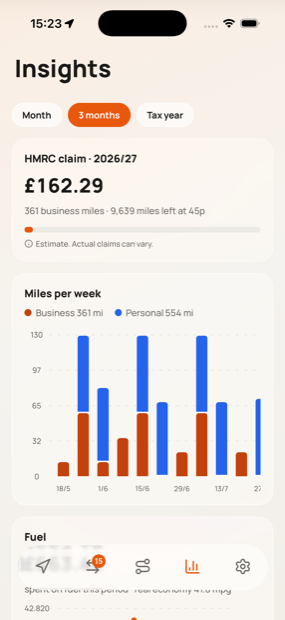
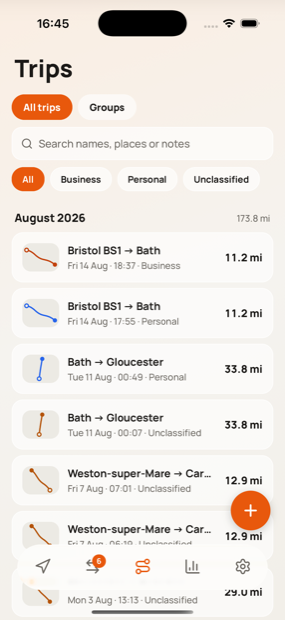
That is the case for recording automatically. Milesheet logs each leg as its own journey, so a day of eleven drops arrives as eleven trips to sort rather than one vague total, and keeps each vehicle's economy and costs separate if you run more than one.
Sources
- Travel, mileage and fuel rates and allowances (HMRC)
- Expenses if you're self-employed: vehicles (HMRC)
- Simplified expenses checker (HMRC)
General information for UK drivers, not tax advice.