 Milesheet
Why your MPG falls off a cliff every winter
Cold engines, denser air, heated everything: the reasons a January tank goes less far than a July one, and how much of it you can do anything about.

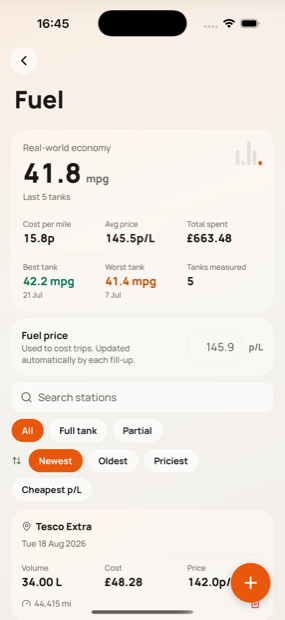
If you keep a fill-up log for a year, the shape that emerges is remarkably consistent: economy peaks in summer, sags through autumn and bottoms out in January or February. A 10–20% swing between best and worst month is entirely normal. Here is where it goes.
The engine spends longer cold
This is the big one, and it is mostly about short journeys. A cold engine runs a richer mixture until it reaches operating temperature, and oil is thicker so there is more drag to overcome. In summer that warm-up might take four or five minutes. In February it takes considerably longer.
If your typical drive is twenty minutes, a large fraction of it is now happening at poor efficiency. If your typical drive is two hours, the warm-up barely registers. The same weather hits a short-hop driver far harder than a motorway one.
Everything electrical is on
Heated seats, heated rear screen, heated mirrors, blowers, lights, wipers. All of it is load on the alternator, and the alternator is turned by the engine, which burns fuel to do it. Individually trivial, collectively noticeable.
Air conditioning, incidentally, usually runs in winter too — most cars use the compressor to dry the air when demisting.
The air is denser
Cold air is denser, which means more aerodynamic drag at any given speed. It is a small effect around town and a real one at motorway speeds.
Tyres lose pressure
Pressure falls as temperature drops, roughly 1–2 PSI for every 10°C. A tyre set correctly in September can be meaningfully soft by December, and soft tyres cost fuel through rolling resistance. This is the one on the list that is free to fix.
Winter fuel is slightly different
Fuel blends are adjusted seasonally for cold-weather performance, and winter blends carry marginally less energy per litre. It is a small contributor, but it is real and it is not something you control.
What actually helps
- Check pressures monthly through winter, not annually
- Combine short trips where you can — one warm engine doing three errands beats three cold starts
- Do not idle to warm up. Modern engines warm faster under gentle load, and idling returns exactly zero miles per gallon
- Take the roof box off when you are not using it
What does not help much: driving more slowly than the traffic, or agonising over the heater. Use the heater. You will not save enough to matter and you will be miserable.
Know your own numbers
The reason to log fill-ups is that this stops being folklore and becomes your car. Milesheet works out MPG between full tanks and charts it, so the winter dip is visible as a shape rather than a suspicion — and if a tank is unusually bad for the time of year, that is worth investigating rather than shrugging at.