 Milesheet
What a litre of petrol is actually made of
Most of what you hand over at the pump is not fuel. Duty is a flat sum per litre, VAT is charged on top of the duty, and the fuel itself is the smaller half.

If you drive for work, fuel is the cost you watch most closely and understand least. It is worth knowing what the pump price is composed of, because two of the three components do not move with the oil price at all.
Three components
The fuel. The product itself, plus refining, distribution and the retailer's margin. This is the part that moves with crude oil and with the exchange rate, and it is the part everyone talks about.
Fuel duty. A flat excise charge, set in pence per litre. Not a percentage. It is the same number of pence whether the underlying fuel is cheap or expensive.
VAT. Charged at the standard rate on the total, including the duty.
The bit that surprises people
That last sentence does the damage. VAT is charged on the duty as well as on the fuel.
So the tax is not additive, it compounds. Every litre carries a fixed sum of duty, and then a fifth of that duty is charged again as VAT. Raising duty by a penny raises the pump price by more than a penny.
It also means the tax take per litre is remarkably stable while the pump price swings. When fuel is expensive, tax is a smaller proportion of a bigger number. When fuel is cheap, duty does not fall with it, so tax becomes a much larger share of what you pay. The floor under the pump price is higher than people expect.
Why the flat duty matters to a business
Two consequences follow directly.
Efficiency is worth more than shopping around. The duty component is identical at every forecourt in the country. The only part you can influence by choosing where to fill up is the fuel and margin portion, which is the smaller share. Improving your actual consumption reduces the litres, and reducing litres reduces all three components at once.
Reclaiming VAT is not reclaiming the tax. A VAT registered business can recover the VAT element on business fuel, subject to the rules. It cannot recover the duty, which is not VAT and is not recoverable by anyone. Recovering VAT on fuel takes back a fifth of a bill that is already mostly duty.
| Moves with oil price | Recoverable by a VAT registered business | |
|---|---|---|
| Fuel, refining, margin | Yes | VAT element only |
| Fuel duty | No, flat per litre | No |
| VAT | Yes, as a percentage of the total | Yes, subject to the rules |
What this does to a mileage claim
The approved mileage rate is meant to cover the whole cost of running a car, of which fuel is roughly a third to a half. So a change in pump prices moves your actual cost per mile without moving the rate at all.
That is the mechanism behind a slow squeeze. The rate is a fixed pence per mile. Your fuel cost per mile is not fixed, and it has a hard floor set by duty that does not fall when oil does. Over a long enough period, a static rate and a rising floor produce a claim that covers less of the cost each year.
The number worth knowing
Not the pump price. Your actual pence per mile.
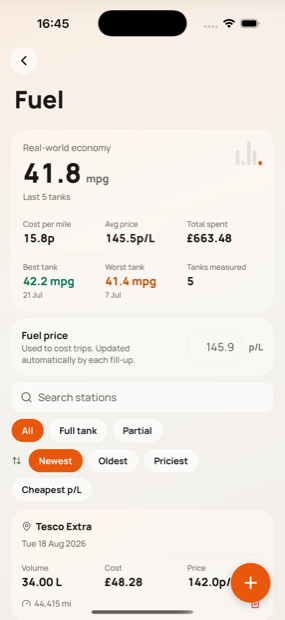
That figure combines the price you paid with the consumption you actually got, and it is the only one that tells you what a journey cost. It is also the one almost nobody knows, because working it out means recording fill-ups with the litres, the price and the odometer, and doing the arithmetic between full tanks.
Milesheet does that arithmetic from your own fill-ups, which is why its cost per mile is a measurement rather than a brochure figure. A car that is 8 mpg off its official number is costing you real money on every journey, and the pump price will never tell you.
Sources
- Fuel duty (HMRC)
- VAT rates (GOV.UK)
- Weekly road fuel prices (Department for Energy Security and Net Zero)
- Travel, mileage and fuel rates and allowances (HMRC)
General information, not tax advice. Duty and VAT rates change: check the current figures on GOV.UK.