 Milesheet
Real MPG: why your car never matches the brochure
Where official economy figures come from, why the gap is normal, and how two full tanks tell you the only number that matters.

Almost nobody gets the fuel economy printed in the brochure. That is not because the manufacturer lied, it is because the figure was never a promise about your driving.
Where the number comes from
Official economy figures come from a standardised laboratory test. Since 2017 that has been WLTP, which replaced the older and much more flattering NEDC cycle. WLTP is a great deal closer to reality than what came before, but it is still a controlled procedure: fixed temperature, a defined speed profile, no headwind, no roof box, no traffic, no you.
Its job is to let you compare two cars fairly. It was never designed to predict what your commute costs.
Why your number is lower
- Short trips. A cold engine is a thirsty engine. Two miles to the station can return half what the same car does on a motorway run.
- Speed. Air resistance climbs with the square of speed. Seventy costs a lot more than sixty.
- Weight and drag. Roof bars, a boot full of tools, a bike rack you left on since June.
- Winter. Denser air, warm-up cycles, lights and heaters. A 10% seasonal swing is unremarkable.
- How you drive. Anticipation is worth more than any gadget you can buy.
Working out the number that actually matters
You only need two things: a full tank, and the next full tank.
- Fill the tank completely and note the odometer.
- Drive as you normally would.
- Fill it completely again, note the odometer and the litres that went in.
Then:
MPG = (miles driven ÷ litres) × 4.546
That 4.546 is the litres in an imperial gallon, which is what UK mpg is quoted in. Miss it and you will produce a US mpg figure that is 20% too low, which is a classic way to convince yourself something is wrong with the car.
One tank is a snapshot. Three or four gives you the number to plan with.
What it is worth knowing
Real economy is what turns a distance into a cost. At 145.9p a litre, a 40-mile round trip costs about £5.80 in a car doing 52 mpg, and about £8.60 in the same journey at 35 mpg. Over a working year that difference is a holiday.
It also decides whether the 55p a mile you can claim is generous or barely covers the fuel. For an efficient car it comfortably covers running costs. For a thirsty one towing a trailer, it is doing well to break even.
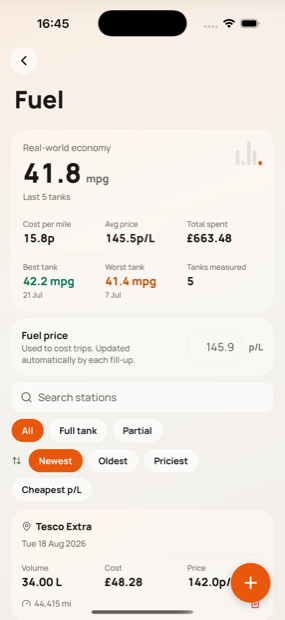
Milesheet works this out for you: log each fill-up with the litres, the cost and the odometer, and it derives your real MPG between full tanks, then prices every journey with your own number instead of the brochure's.
What the gap typically looks like
Real-world economy usually lands below the official figure. The size of the gap varies by powertrain more than by brand:
| Powertrain | Typical shortfall against official | Why |
|---|---|---|
| Petrol, non-turbo | 5-15% | Closest to the test conditions |
| Petrol, small turbo | 15-25% | Test rewards low-load running the real world does not do |
| Diesel | 10-20% | Efficient on long runs, poor on short ones |
| Hybrid | 10-30% | Depends entirely on journey length and temperature |
| Plug-in hybrid | Can be enormous | Official figure assumes you charge it |
The plug-in case is the one that misleads most. A PHEV driven without charging returns something close to a heavy petrol car, not the headline figure.
Working out your own, properly
You need two full-tank fills with odometer readings:
| Step | Example |
|---|---|
| Fill to the brim, note odometer | 44,120 mi |
| Drive normally | n/a |
| Fill to the brim again, note odometer and litres | 44,472 mi, 38.6 L |
| Miles covered | 352 |
| Gallons used (litres ÷ 4.546) | 8.49 |
| Real MPG | 41.5 |
The brim matters more than the arithmetic. Filling to the first click both times is what makes the two measurements comparable; a splash-and-dash in the middle is fine as long as you add its litres in.
What it changes
| Figure | Using the brochure (52 mpg) | Using the real number (41.5 mpg) |
|---|---|---|
| Cost per mile at 145p/L | 12.7p | 15.9p |
| Fuel for 10,000 miles | £1,268 | £1,590 |
| Fuel on a 300-mile round trip | £38 | £48 |
| Is 55p a mile generous? | Very | Comfortably, but less so |
A 25% error in economy is a 25% error in every journey cost you calculate, including what you tell friends they owe for petrol.