 Milesheet
Nine ways to cut fuel costs on the same commute
No new car, no lifestyle change. The habits and checks that actually move the needle, roughly in order of what they are worth.

You cannot always change the journey. You can change what it costs. Roughly in order of what they return:
1. Ease off the throttle
Air resistance rises with the square of speed, so the last ten miles per hour are the expensive ones. Dropping from 75 to 65 on a motorway run typically saves in the region of 10 to 15% of the fuel, and costs you a couple of minutes an hour.
2. Anticipate instead of react
Lifting early for a red light rather than braking late is free. Every drop of fuel you spend building speed you then throw away as heat in the brakes. This is the single biggest difference between two people driving the same route in the same car.
3. Check your tyre pressures
Under-inflated tyres increase rolling resistance measurably, and most cars on the road are down a few PSI. It takes five minutes a month, helps the tyres last longer, and is a safety item anyway.
4. Take the roof bars off
A roof rack or box is a serious aerodynamic penalty at motorway speed, easily 10 to 20% on a small car. If it has been on since the summer holiday, that is expensive storage.
5. Empty the boot
Weight matters most in town, where you are accelerating repeatedly. The bag of sand from a job in March is not helping.
6. Combine trips
A cold engine is dramatically less efficient for the first few miles. Three short errands from cold cost far more than one loop that does all three.
7. Buy fuel on price, not on habit
Supermarket forecourts are usually cheaper than motorway services by a wide margin. Filling up before a long run rather than on it is often worth several pounds a tank for a two-minute detour.
8. Service it when it asks
A clogged air filter, tired plugs or the wrong oil grade all cost economy. Servicing is not just about avoiding failure.
9. Know your real number
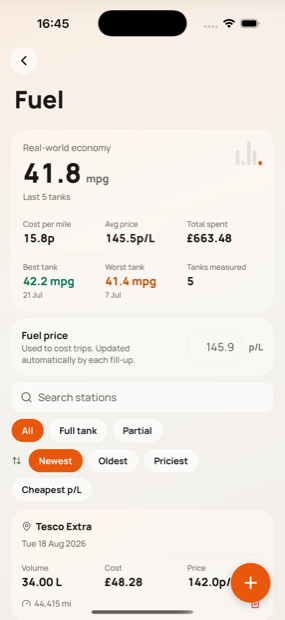
You cannot manage what you do not measure. Work out your actual MPG between two full tanks rather than trusting the trip computer, which is often optimistic by a few percent.
The one that pays for all the others
If any of your driving is for work, the mileage claim is worth more than every tip above combined. At 55p a mile, 200 business miles a month is £1,320 a year of allowance, and for an efficient car that is comfortably more than the fuel it burned.
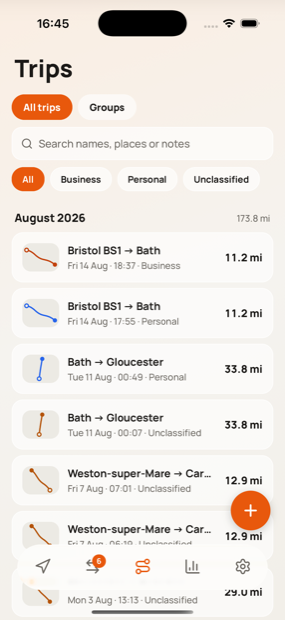
The catch is that unclaimed miles are worth nothing. That is the entire reason Milesheet exists: record the journey while it happens, sort it in seconds, and let the claim add itself up.
What each habit is actually worth
Ranked by what it saves on 10,000 miles a year at 45 mpg and 145p a litre, roughly £1,460 of fuel:
| Change | Typical saving | Per year | Effort |
|---|---|---|---|
| Take the roof box or bars off | 5-20% when fitted | up to £290 | Ten minutes |
| Keep tyres at the right pressure | 2-4% | £30-£60 | Five minutes a month |
| Ease off from 80 to 70 on motorways | 10-15% of motorway miles | varies | Free |
| Combine short trips into one | 5-10% for short-trip drivers | £70-£145 | Planning |
| Lose 50 kg of junk from the boot | 1-2% | £15-£30 | Fifteen minutes |
| Service on schedule, right oil | 1-3% | £15-£45 | Already doing it |
| Air con off in town | 1-3% in summer | Small | Uncomfortable |
The top two are the ones worth actually doing: high value, near-zero effort, and neither of them makes the drive worse.
The ones that are mostly myth
| Claim | Reality |
|---|---|
| "Fill up when it's cold, fuel is denser" | The difference is far below what you can measure |
| "Premium fuel improves economy" | Only in engines that require it; otherwise negligible |
| "Coasting in neutral saves fuel" | Modern engines cut fuel on the overrun; neutral uses more |
| "Half a tank saves weight" | ~20 kg. Below the noise, and you refuel twice as often |
| "Warm the engine up on the drive" | Idling returns 0 mpg. Drive gently instead |
And the one that dwarfs all of them
If any of your driving is for work, the mileage claim is worth more than every habit above combined:
| Annual value | |
|---|---|
| Every fuel-saving habit above, done diligently | £150-£400 |
| 200 business miles a month, claimed at the approved rates | £1,080 |
The catch is that unclaimed miles are worth nothing at all, which is the entire reason to keep a record.