 Milesheet
What makes HMRC look twice at a mileage claim
Round numbers, impossible days, claims that never change, and the other patterns that invite a question you would rather not answer.

Most mileage claims are never looked at. The ones that are tend to share a handful of characteristics, and none of them are about the amount being large.
Round numbers everywhere
Real driving does not produce round numbers. A month of genuine journeys totals 847 miles, not 850. A claim made of tidy fifties and hundreds looks estimated because it usually is.
This is the single most common tell, and it is entirely avoidable: record the distance you actually drove.
The same figure every month
A claim of exactly 500 miles in twelve consecutive months describes a standing order, not a working year. Real mileage moves with holidays, weather, illness, quiet Augusts and busy Novembers.
If your driving genuinely is that regular, the record will show it — but it will show it as 512, 486, 503, not 500 twelve times.
Days that could not have happened
Claims that require being in two places at once, or covering 400 miles in a working day that also contained six hours of meetings, do not survive contact with a calendar. Reconstructing a year from memory produces these without anyone intending to mislead.
No evidence of the journey's purpose
The distance is only half of it. HMRC's expectation is that you can say why a journey was business — which client, which site, which job. "Business mileage: 340" is a number, not a record.
Commuting mixed in
Home to a permanent workplace is not claimable, and a claim that quietly includes it is the most common substantive error rather than a presentational one. If a pattern of identical journeys on identical weekdays runs through the log, it invites exactly the question you do not want.
What a good record looks like
For each journey: the date, where you went from and to, why it was business, and how far. Kept as you go, not assembled afterwards. Retained for at least 22 months after the end of the tax year if you are employed, or five years after the filing deadline if self-employed.
The reason contemporaneous records matter is not bureaucratic. It is that they are checkable — against your calendar, your invoices, your fuel receipts and your odometer — and a claim that agrees with four other sources is not a claim anyone spends long on.
The quiet advantage of recording automatically
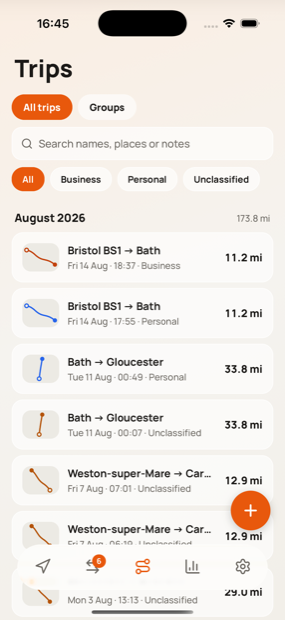
A log that writes itself as you drive is contemporaneous by definition. It produces the awkward, specific numbers real driving makes, it carries the route rather than just the total, and it cannot accidentally include the school run because nobody was reconstructing anything in April.
Milesheet records each journey as it happens, keeps commuting out of the claim once home and workplace are tagged, and exports the year as a CSV or PDF that shows the individual journeys rather than a monthly figure.
Sources
- HMRC — Self Assessment: keeping your records
- HMRC — 490: Employee travel, a tax and NICs guide
- HMRC — Claim tax relief for your job expenses: vehicles you use for work
- HMRC — Travel, mileage and fuel rates and allowances
General information for UK drivers, not tax advice.