 Milesheet
What a mileage log has to prove, wherever you file it
Four tax authorities, four rate structures, and near-identical expectations about evidence. The rate varies. What counts as a record barely does.


Update, April 2026: the UK approved rate for cars and vans rose from 45p to 55p a mile for the first 10,000 business miles. The 25p rate above that, and the 5p passenger payment, are unchanged. This post describes the position as it stood when it was written.
The interesting thing about comparing mileage systems is how much they disagree about the money and how little they disagree about the paperwork.
The four facts, everywhere
Britain, America, Germany and France ask for the same four things about a business journey:
- The date it happened
- Where you went, specifically enough to identify it
- Why, in business terms
- How far it was
That is the whole list. There is no jurisdiction where a bare monthly total is sufficient, and none where the four facts are not enough.
Contemporaneous, and they mean it
The word that does the work is contemporaneous: written at the time, or close to it.
The IRS is the most explicit about this, asking for records made at or near the time of the journey, on the reasoning that a record made later is a reconstruction and a reconstruction is an estimate. HMRC's wording is softer but the expectation is the same in substance, and the practical test is identical: could you produce, journey by journey, something you did not invent in April?
This is the single most common failure. Not fraud, not exaggeration, just a year of driving reconstructed from a diary and a rough sense of the route, which produces round numbers, plausible distances and nothing that survives being questioned.
What makes a claim look wrong
The patterns that attract attention are also broadly shared.
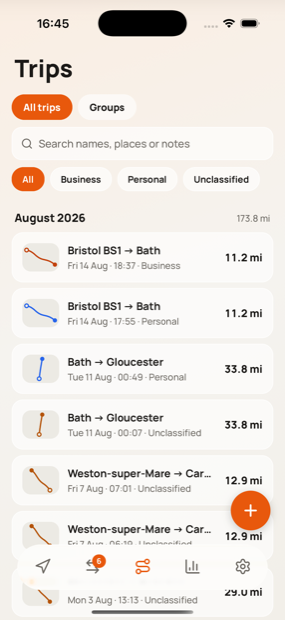
Round numbers. Real journeys are 11.2 miles and 33.8 miles. A log of 10s, 20s and 50s is a log of estimates.
Totals that do not reconcile with the odometer. If your log says 8,000 miles and the car did 20,000, the gap is not itself a problem, but it should be explicable. If the log says 22,000 and the car did 20,000, that is a problem.
Commuting inside the claim. Every one of these systems excludes the ordinary commute in one way or another, and a claim that quietly includes it is the error auditors find fastest.
A claim that ends exactly at a threshold. Ending the year at 9,998 business miles is not evidence of anything, but it is the kind of coincidence that invites a second look.
What differs
Only two things, really.
Who keeps the record. In Britain and America the driver keeps it and produces it if asked. In systems built around employer reimbursement, such as Spain and Ireland, the employer's payroll records carry more of the weight, though the driver still needs to be able to justify the underlying journeys.
How long to keep it. The retention periods differ by jurisdiction, and the safe answer everywhere is longer than you think and longer than the year the claim relates to.
The practical version
| The record must | UK | US | Germany | France |
|---|---|---|---|---|
| Date each journey | Yes | Yes | Yes | Yes |
| Name the destination | Yes | Yes | Yes | Yes |
| State the business purpose | Yes | Yes | Yes | Yes |
| Give the distance | Yes | Yes | Yes | Yes |
| Be made at the time | Expected | Explicitly | Expected | Expected |
| Exclude commuting | Yes | Yes | Separate allowance | Yes |
Why this is an argument for automation
The four facts are easy to know and easy to lose. Three of them, the date, the destination and the distance, are things a phone in a moving car already knows. Only the reason is genuinely yours to supply.
That is the whole design argument for recording a drive as it happens rather than writing it up later: it moves three of the four facts from memory into evidence, and leaves you with one thing to add while you still remember it.
Sources
- Publication 463, Travel, Gift, and Car Expenses (IRS)
- Topic no. 510, Business use of car (IRS)
- Ordinary commuting and private travel (490: Chapter 3) (HMRC)
- Keeping your pay and tax records (HMRC)
- Claim Income Tax relief for your employment expenses (P87) (HMRC)
General information, not tax advice. Retention periods and evidence rules vary: check with the authority you file under.