 Milesheet
Tax years that do not start in January, and what they do to a claim
Britain resets on 6 April, most of Europe on 1 January, and Japan in April. If your mileage threshold resets on a date you have not noticed, your claim is wrong.


Update, April 2026: the UK approved rate for cars and vans rose from 45p to 55p a mile for the first 10,000 business miles. The 25p rate above that, and the 5p passenger payment, are unchanged. This post describes the position as it stood when it was written.
Most of the arithmetic in a mileage claim is obvious. The date the counter goes back to zero is not, and it is the one that quietly ruins totals.
Britain resets on 6 April
The UK tax year runs from 6 April to 5 April. That is the date your 10,000 mile threshold resets, and it is the reason a journey on 4 April can be worth 25p and the identical journey on 7 April worth 45p.
The 6 April date is a historical accident, a leftover of the old Lady Day quarter day and the calendar reform of 1752, and it survives because moving it would be more trouble than living with it.
For a driver, the consequence is concrete. If you are at 9,700 business miles in late March, the last few hundred miles of the year are worth 25p and the first few hundred of the new year are worth 45p. That is not a loophole to exploit, but where you have genuine discretion about when a long trip happens, it is worth knowing which side of the line you are on.
Most of Europe resets on 1 January
Germany, the Netherlands, Spain and France all work on the calendar year.
For Germany and the Netherlands this is simple, because their rates are flat: there is no threshold to reset, so the year boundary only matters for which year's figure applies.
For France and Ireland it matters much more, because both taper the rate as annual distance rises. A French driver's rate depends on how far they have already driven this calendar year, so the reset on 1 January genuinely changes what the next kilometre is worth.
Japan runs April to March
Japan's tax year runs from 1 April to 31 March, which happens to be almost the British year without the six day offset.
Because Japan has no national per kilometre business rate, the year boundary does not reset a threshold. It matters for the monthly commuting allowance ceilings and for when an employer's own scheme rolls over, which is a payroll question rather than a mileage one.
America runs the calendar year, with mid-year rates
The US tax year is the calendar year, but the IRS reserves the right to change the standard mileage rate part way through when fuel moves sharply. It did so in 2022, applying one rate to January to June and another to July to December.
That produces a different kind of boundary problem: not a threshold resetting, but two rates inside a single year. A US log has to know which side of 30 June a journey fell on, which is a date that appears nowhere in the tax year itself.
The four boundaries
| Year starts | Threshold to reset | Mid-year rate changes | |
|---|---|---|---|
| UK | 6 April | Yes, 10,000 miles | No |
| Germany | 1 January | No, flat rate | No |
| France | 1 January | Yes, several bands | No |
| Japan | 1 April | No national rate | n/a |
| US | 1 January | No | Occasionally |
Why this catches people out
Two failure modes, both common.
The spreadsheet that runs January to December in a country that does not. A British driver totalling by calendar year gets a threshold in the wrong place and a claim that does not match what HMRC expects. It usually looks close enough to go unnoticed.
The move. Someone who has driven for work in one country and starts in another carries the old boundary in their head. The rate is the thing people check when they move. The year start is not.
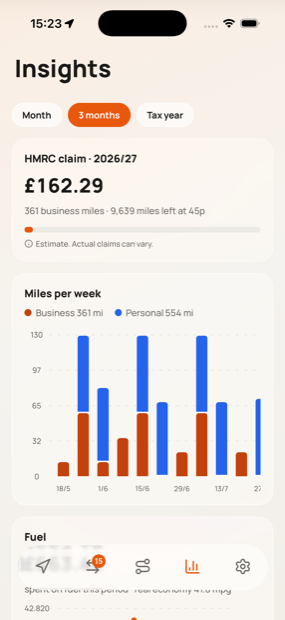
Milesheet holds the year start as part of the scheme rather than as a global setting, so switching schemes moves the boundary with it. The UK scheme resets on 6 April, the calendar year schemes on 1 January, and the running total that decides which band a journey falls into follows the same boundary.
Sources
- Travel, mileage and fuel rates and allowances (HMRC)
- Expenses and benefits: business travel mileage (HMRC)
- Frais de transport (impots.gouv.fr)
- Standard mileage rates (IRS)
- No.2585 マイカー・自転車通勤者の通勤手当 (National Tax Agency)
General information, not tax advice. Check the year boundary and the current rate with the authority you file under.