 Milesheet
A tax year end checklist for anyone who drives for work
What to do in the fortnight before 5 April, and the three things that are much harder to fix afterwards.

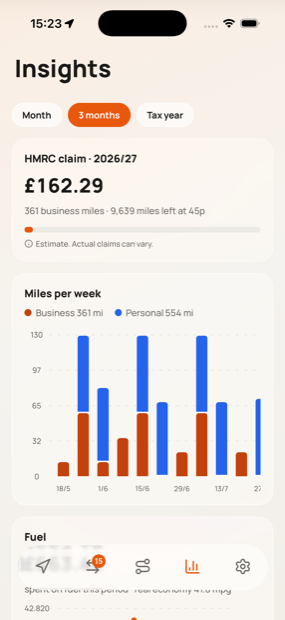
The UK tax year ends on 5 April. Nothing dramatic happens on the day, but a few things get considerably harder once it has passed. Here is the short list.
1. Sort anything still unclassified
An unclassified journey is in no total. If you have a backlog of trips you never got round to marking business or personal, that is money sitting in a queue.
Do it now while you can still remember what a Tuesday in November was for. In six months you will be guessing, and a guessed log is a weak log.
2. Check your business mileage against the 10,000 line
The rate drops from 45p to 25p once you pass 10,000 business miles in the tax year, and the counter resets on 6 April.
This matters for planning if you are close to it. Nobody is suggesting you invent journeys — but if you have discretion over when a long trip happens, and you are at 9,800 miles in late March, the same drive is worth 45p a mile in April rather than 25p now.
3. Reconcile your odometer
This is the one people skip and later regret. Compare what your odometer says against what your log accounts for. If the car has covered 14,000 miles and your journeys add up to 11,000, then 3,000 miles went unrecorded — and unrecorded business miles cannot be claimed.
You will not recover all of it, but a gap between two known dates is a far better prompt for your memory than a blank year. Milesheet does this comparison for you from your fill-up odometer readings and flags stretches where the two disagree.
4. Collect the out-of-pocket costs
Parking, tolls, congestion and clean-air charges on business journeys are claimable separately from mileage — the mileage rate covers running the vehicle, not what you paid to leave it somewhere.
Receipts are easier to find in April than in January. If you photograph them onto the journey as you go, this step is already done.
5. Export before you need it
Produce the CSV and the claim PDF for the year while everything is fresh, and put them somewhere that is not only your phone. If you file in January, the version of events you want is the one you assembled in April.
6. Check how long to keep it
Records need keeping for at least 22 months after the end of the tax year if you are employed, and five years after the 31 January filing deadline if you are self-employed. Deleting last year's log to tidy up is a bad trade.
Sources
- HMRC — Self Assessment: keeping your records
- HMRC — Travel, mileage and fuel rates and allowances
- HMRC — Claim Income Tax relief for employment expenses (P87)
- HMRC — Expenses if you're self-employed: vehicles
General information for UK drivers, not tax advice.