 Milesheet
Self-employed: the same 45p, by a completely different route
Employees claim relief on a shortfall. Sole traders deduct simplified expenses from profit. The rate is identical and almost nothing else is.


Update, April 2026: the approved rate for cars and vans rose from 45p to 55p a mile for the first 10,000 business miles. The 25p rate above that is unchanged. This post describes the position as it stood when it was written.
The number is the same, which is why people assume the mechanism is. It is not, and the differences decide what you can actually claim.
Two different things called a mileage claim
An employee is reimbursed by an employer. If that reimbursement is below the approved rate, the employee claims tax relief on the gap, through Self Assessment or a P87. The claim is for relief on a shortfall, and its size depends on what the employer paid.
A sole trader has no employer and no reimbursement. They deduct a simplified expense from business profit: business miles multiplied by the flat rate, taken off the profit the tax is calculated on. There is no shortfall, because there was never a payment.
So an employee's claim gets smaller the more their employer pays. A sole trader's claim depends only on how far they drove.
The rate is the same, the bands are the same
Both use 45p for the first 10,000 business miles in the year and 25p after. Both reset with the tax year on 6 April. Both count miles across every vehicle rather than per car.
That shared structure is why the two get conflated, and it is genuinely the only part that is shared.
The choice a sole trader has, and an employee does not
This is the real divergence.
A sole trader can use the flat rate, or they can claim actual costs: the business proportion of fuel, insurance, servicing, repairs, and capital allowances on the vehicle itself. Whichever gives the better answer.
An employee has no such choice. The approved rate is the approved rate.
Two things make the choice consequential.
It can be worth substantially more or less. An expensive vehicle doing modest business mileage often does better on actual costs, because the capital allowances and the insurance are large and the mileage is not. A cheap, economical car doing high mileage almost always does better on the flat rate.
It is sticky. Once you use the flat rate for a particular vehicle, you must keep using it for that vehicle for as long as you have it. You cannot alternate year by year to whichever suits, and the decision is effectively made the first time you claim for that car.
That last point is the one that catches new traders. The first year's choice, often made without thinking, binds every year after it.
| Employee | Sole trader | |
|---|---|---|
| Claims against | A shortfall in reimbursement | Business profit |
| Rate | 45p, then 25p | 45p, then 25p |
| Can claim actual costs instead | No | Yes |
| Choice is reversible | n/a | No, per vehicle |
| Route | Self Assessment or P87 | Self Assessment |
| Passenger supplement | 5p, employer's option | Not applicable |
What both need to evidence
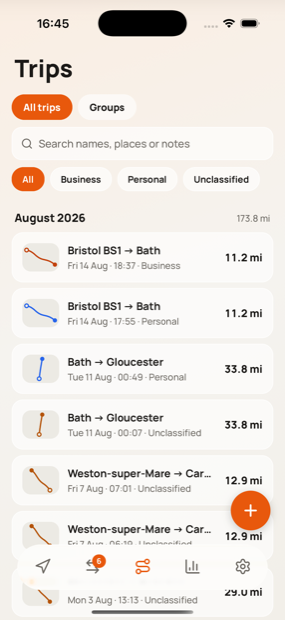
Identical, and unremarkable: date, destination, business purpose, distance, recorded at the time.
The sole trader carries one extra burden. Because the flat rate is a deduction against profit rather than a reimbursement someone else calculated, nobody is checking the arithmetic on the way through. An employee's claim passes across an employer's desk. A sole trader's does not pass across anyone's until it is questioned.
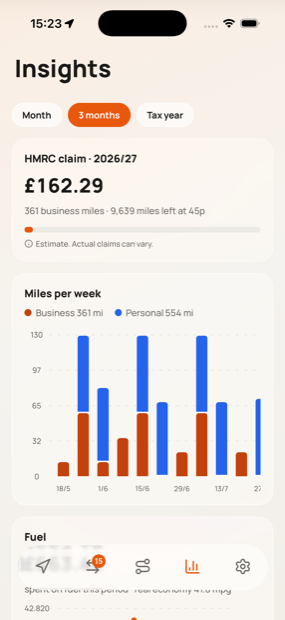
That makes the log the entire evidence base, and it makes the 10,000 mile boundary something you have to know your position against all year rather than discover in January.
Sources
- Simplified expenses if you are self-employed: vehicles (HMRC)
- Simplified expenses if you are self-employed (HMRC)
- Tax relief for employees: business mileage and fuel costs (HMRC)
- Self Assessment tax returns (GOV.UK)
- Travel, mileage and fuel rates and allowances (HMRC)
General information, not tax advice. The flat rate against actual costs decision is hard to reverse: check with your accountant before making it.