 Milesheet
Territory driving: when 25,000 miles a year is the job
The 10,000-mile threshold arrives in May, the car wears out in three years, and the arithmetic is different from everyone else's.

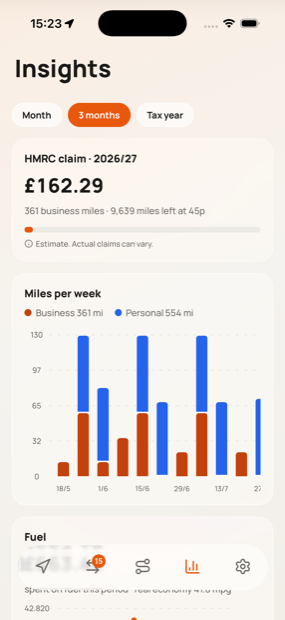
Field sales, area management, regional service engineering — jobs where the driving is not incidental to the work, it substantially is the work. The tax treatment was not designed with them in mind.
The threshold arrives early
At 25,000 business miles a year you pass 10,000 in about the fifth month of the tax year. Everything after that is at 25p.
The blended rate works out around 33p a mile. Someone doing 8,000 miles gets the full 45p on all of it. The higher-mileage driver, whose costs are demonstrably greater, is paid a lower average rate per mile.
That is the structural quirk of the system, and it is why high-mileage drivers should be the most diligent about claiming everything they are entitled to — there is less margin in it than the headline rate suggests.
When the threshold arrives
| Annual business miles | 10,000 reached | Blended rate | Total allowance |
|---|---|---|---|
| 10,000 | 5 April | 45.0p | £4,500 |
| 15,000 | early January | 38.3p | £5,750 |
| 20,000 | early October | 35.0p | £7,000 |
| 25,000 | mid August | 33.0p | £8,250 |
| 30,000 | early July | 31.7p | £9,500 |
| 40,000 | mid May | 29.4p | £11,750 |
Assuming even mileage through the year. The point of the table is the middle column: the driver doing 40,000 miles is paid an average of 29.4p for driving that costs them considerably more than the driver doing 8,000.
Three things worth knowing if this is you
Timing matters at the boundary. Not to manipulate — but if you have genuine discretion over when a long trip happens and you are at 9,700 miles in late March, the same journey is worth 45p in April rather than 25p now. Knowing where you stand requires a running total, which is exactly what most people do not have.
Your car is a consumable. At 25,000 miles a year a car does 75,000 in three years, and depreciates accordingly. If you are choosing between a company car and your own, run the numbers on your actual mileage rather than a typical one — the answer for a high-mileage driver often differs from the office default.
Real MPG matters more. At 25,000 miles, a 5 mpg difference between the brochure figure and reality is hundreds of pounds a year. It also changes whether 45p is generous or thin.
Where high-mileage claims go wrong
Reconstructing at year end. Nobody remembers 800 journeys. A reconstruction produces round numbers and impossible days, which is the pattern most likely to attract a question — and the sums here are large enough for one.
Missing the short hops. The long runs get remembered. Three miles between two customers in the same town, twelve times a week, does not — and over a year it is thousands of miles.
Commuting mixed in. With no fixed office the position may be favourable, but if there is a base you attend, those journeys are not claimable and a large claim containing them is conspicuous.
The practical answer
Automatic recording, sorted weekly, with regular customers tagged so most of it classifies itself. At this mileage the difference between a log that keeps itself and one that depends on you is not convenience — it is whether the claim is defensible at all.
Sources
- HMRC — Travel, mileage and fuel rates and allowances
- HMRC — Claim tax relief for your job expenses: vehicles you use for work
- HMRC — 490: Employee travel, a tax and NICs guide
- HMRC — Self Assessment: keeping your records
General information, not tax advice.