 Milesheet
Mileage for trades: eleven drops a day and no time to write anything down
The people with the most business mileage are the least able to record it as it happens. That is a solvable problem.

A plumber doing six calls in a day covers more claimable mileage than an office worker does in a fortnight. They are also the least likely to have recorded any of it, for the obvious reason: nobody stops between jobs to write down a four-mile hop.
What that costs
Six local calls averaging five miles between them is 30 miles a day. Over 230 working days that is roughly 6,900 business miles — about £3,100 of allowance at the approved rates.
The miles between jobs are the ones that go missing. The long run to the merchant gets remembered; eleven short hops do not.
What a working day adds up to
| Calls per day | Miles between | Daily | Annual (230 days) | Approved amount |
|---|---|---|---|---|
| 4 | 6 | 24 | 5,520 | £2,484 |
| 6 | 5 | 30 | 6,900 | £3,105 |
| 8 | 4 | 32 | 7,360 | £3,312 |
| 11 | 4 | 44 | 10,120 | £4,530 |
| 14 | 3 | 42 | 9,660 | £4,347 |
Plus the merchant runs, which are business travel and rarely recorded.
The mistakes that cost most
Recording the day, not the journeys. "Tuesday: 40 miles" is an estimate. It cannot be checked against anything, and it is the pattern most likely to draw a question.
Forgetting the merchant run. A trip to the wholesaler mid-job is business travel. So is the trip to collect a part, and the one back.
Treating the first and last journeys as commuting by default. If you have no permanent workplace — you go from home directly to whichever site is next — the position is different from an employee driving to a fixed office. It is worth establishing which you are, because it changes the first and last journey of every working day, every day.
Not separating the van. If you run a van and a car, they need to be separate records with separate economy. Mixed together, neither figure means anything.
Which journeys count in a trade
| Journey | Claimable? |
|---|---|
| Home → first job of the day (no fixed base) | Usually yes |
| Home → depot or workshop you attend daily | No — commuting |
| Job → job | Yes |
| Job → merchant for parts → job | Yes, both legs |
| Depot → job | Yes |
| Last job → home (no fixed base) | Usually yes |
| Detour to collect lunch | The business element only |
Whether you have a permanent workplace decides the first and last journey of every working day, which over a year is the largest single item on the list.
The rate question for a van
Vans use the same 45p and 25p rates as cars, which suits an economical small van and can undercook a big one working hard. If your vehicle is thirsty, high-mileage and expensive to maintain, actual costs may be worth more — but the choice is close to permanent per vehicle, so do the arithmetic before defaulting to the simple option.
Recording without stopping
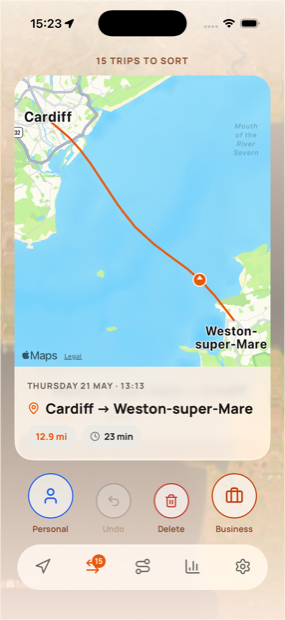
This is the case for automatic recording rather than a notebook. Milesheet notices you leaving where you parked, records the drive, and stops when you have been still for a few minutes — so eleven drops arrive as eleven journeys, each with its own distance and route.
At the end of the week the whole lot sorts in a minute with a few swipes, and tagging your regular merchants and repeat customers means most of it sorts itself.
Sources
- HMRC — Travel, mileage and fuel rates and allowances
- HMRC — Expenses if you're self-employed: vehicles
- HMRC — 490: Employee travel, a tax and NICs guide
- HMRC — Self Assessment: keeping your records
General information, not tax advice. Whether you have a permanent workplace is fact-specific and matters a lot here: take advice.