 Milesheet
Community care: forty short visits and nobody counting
Care workers and community nurses cover serious mileage in five-minute hops, and it is the most under-recorded driving in the country.

Domiciliary care and community nursing produce a driving pattern almost no other job does: dozens of very short journeys, tight schedules, and no natural pause in which to write anything down.
The mileage is larger than it feels
Twelve visits a day averaging three miles between them is 36 miles. Over 220 working days that is roughly 7,900 miles a year — comparable to a sales rep, accumulated three miles at a time.
At the approved rates that is around £3,500 of allowance. Recorded as "about 30 miles a day", it becomes a round number that is both hard to defend and almost certainly wrong.
What a typical round adds up to
| Visits per day | Miles between visits | Daily miles | Annual (220 days) | Approved amount |
|---|---|---|---|---|
| 8 | 2 | 16 | 3,520 | £1,584 |
| 12 | 3 | 36 | 7,920 | £3,564 |
| 15 | 4 | 60 | 13,200 | £5,740 |
| 18 | 5 | 90 | 19,800 | £7,450 |
The last two rows cross the 10,000-mile threshold, so the totals are banded rather than a flat 45p.
What an underpaying employer costs you
On 7,920 business miles, where the approved amount is £3,564:
| Employer pays | You receive | Shortfall | Relief at 20% |
|---|---|---|---|
| 45p | £3,564 | £0 | — |
| 35p | £2,772 | £792 | £158 |
| 30p | £2,376 | £1,188 | £238 |
| 25p | £1,980 | £1,584 | £317 |
| Nothing | £0 | £3,564 | £713 |
And it can be claimed for the current year plus the previous four.
Where the rules bite
The first and last journeys. If you have a base you attend — an office, a depot, a clinic — travel from home to it is ordinary commuting. If you go from home directly to your first client and home from your last, the position is different and often more favourable.
Which of those you are in is a question about your contract and working pattern, not about how it feels. It is worth establishing once, properly, because it affects two journeys every working day.
Reimbursement below the approved rate. Many employers in the sector pay a per-mile rate lower than HMRC's approved figure. Where that happens, the employee can claim tax relief on the difference through Self Assessment or a P87 — and a great many never do.
On 7,900 miles, an employer paying 30p against an approved 45p leaves relief due on roughly £1,185 of shortfall. For a basic-rate taxpayer that is around £237 of tax back, for filling in a form.
Passenger payments. If you carry a colleague on a work journey, 5p a mile per head is available — but only if the employer pays it. It cannot be claimed as relief if they do not.
The recording problem, honestly
Nobody is going to stop between a medication round and a personal care visit to log three miles. Any system that depends on that will fail, and the resulting log will be a reconstruction.
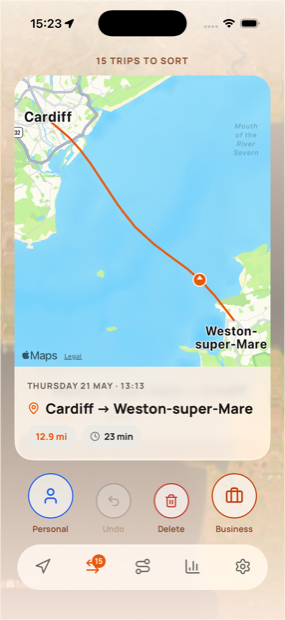
Automatic recording is the only realistic answer here. Milesheet notices you setting off, records the drive, and stops when you have been still for a few minutes — so forty visits arrive as forty journeys with real distances, and the whole day sorts in seconds afterwards.
Tagging the regular addresses means most of it classifies itself.
Sources
- HMRC — Travel, mileage and fuel rates and allowances
- HMRC — Claim tax relief for your job expenses: vehicles you use for work
- HMRC — Claim Income Tax relief for employment expenses (P87)
- HMRC — 490: Employee travel, a tax and NICs guide
General information, not tax advice. Whether you have a permanent workplace is fact-specific and matters here: take advice.