 Milesheet
Your employer pays 25p. Here is how to claim the rest
Mileage Allowance Relief is the most commonly unclaimed thing in the UK tax system, and it takes about ten minutes.

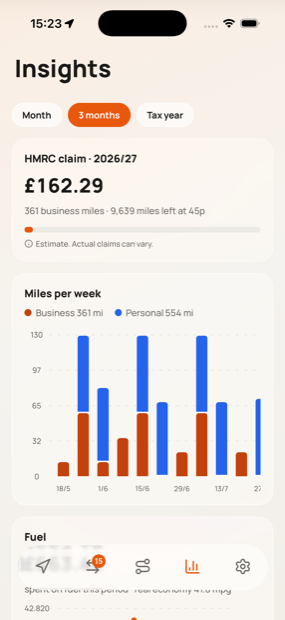
Plenty of employers reimburse business mileage below HMRC's approved rate. Some pay 30p, some 25p, some a fixed amount per journey, some nothing at all.
In every one of those cases the employee can claim tax relief on the difference. Most do not, usually because nobody has ever told them it exists.
How it works
The approved rate is 45p a mile for the first 10,000 business miles in a tax year, then 25p. If your employer pays less, you claim relief on the gap.
Worked example. You drove 4,000 business miles and were paid 25p:
- Approved amount: 4,000 × 45p = £1,800
- Actually paid: 4,000 × 25p = £1,000
- Relief due on: £800
You do not receive £800. You receive tax relief on it — so a basic-rate taxpayer gets around £160, a higher-rate taxpayer around £320.
The four-year backdating table
Relief can generally be claimed for the current tax year and the previous four. For someone paid 25p who has never claimed:
| Business miles per year | Approved amount | Paid at 25p | Shortfall | Relief at 20% | Over five years |
|---|---|---|---|---|---|
| 3,000 | £1,350 | £750 | £600 | £120 | £600 |
| 6,000 | £2,700 | £1,500 | £1,200 | £240 | £1,200 |
| 10,000 | £4,500 | £2,500 | £2,000 | £400 | £2,000 |
| 15,000 | £5,750 | £3,750 | £2,000 | £400 | £2,000 |
Higher-rate taxpayers double every figure in the last two columns.
The catch is the same as always: you can only claim what you can evidence, and a five-year-old claim needs five-year-old records.
What if they pay nothing at all
Then the relief is on the whole approved amount. On 4,000 miles that is relief on £1,800, worth about £360 at basic rate.
This is the case where the sums get genuinely worth having, and it is common in sectors where mileage is treated as part of the job rather than as a reimbursable cost.
How to claim
If you file Self Assessment, it goes in the employment expenses section.
If you do not, use form P87 — claim Income Tax relief for employment expenses. It can be done online.
You can generally claim for the previous four tax years as well as the current one, which for someone who has never claimed can mean a meaningful lump sum.
What HMRC will want
The amounts, and the ability to evidence them: business miles by tax year, what your employer paid you, and a record of the journeys behind the figures.
That last part is where claims fall over. "About 4,000 miles" is not evidence. A journey-level log with dates, destinations, purposes and distances is.
The bit that catches people
Passenger payments cannot be claimed this way. If your employer does not pay the 5p per passenger mile, there is nothing to claim relief on — the relief covers the vehicle rate only. Ask the employer instead.
Commuting never counts, regardless of what the employer pays for.
Getting the number
If you have been recording journeys, the figure already exists. If you have not, this is the argument for starting now rather than in April: four years of relief is worth claiming, and you can only claim what you can evidence.
Sources
- HMRC — Claim tax relief for your job expenses: vehicles you use for work
- HMRC — Claim Income Tax relief for employment expenses (P87)
- HMRC — Travel, mileage and fuel rates and allowances
- HMRC — Self Assessment: keeping your records
General information, not tax advice.