 Milesheet
A car allowance is not mileage, and confusing them costs money
One is taxed as pay, the other is not. Plenty of people receive both, and a surprising number believe the allowance means they cannot claim anything else.


Update, April 2026: the approved rate for cars and vans rose from 45p to 55p a mile for the first 10,000 business miles. The 25p rate above that, and the 5p passenger payment, are unchanged. This post describes the position as it stood when it was written.
A monthly car allowance and a mileage payment are different mechanisms that happen to arrive in the same bank account. Treating them as one thing is a reliable way to lose a claim.
What each one is
A car allowance is a fixed sum, usually monthly, paid because your job requires you to have a car available. It is paid whether you drive 200 miles or 20,000. It goes through payroll, and it is taxed as ordinary pay, with income tax and National Insurance deducted like salary.
A mileage payment is per mile actually driven on business. Paid at or below the approved rate, it is not taxable at all, because it is reimbursing a cost rather than paying you for anything.
The tax treatment is the tell. Money taxed as salary is salary, whatever it is called on the payslip.
The mistake that costs the most
Here is the belief worth dismantling: "I get a car allowance, so I cannot claim mileage."
Receiving a car allowance does not stop you claiming for business miles. The allowance covers having the car. The mileage covers using it for work. They answer different questions.
What actually happens in most car allowance arrangements is that the employer pays a lower pence per mile alongside the allowance, often well below the approved rate. And where an employer reimburses below the approved rate, the employee can claim the difference through Mileage Allowance Relief.
So the driver on an allowance plus a low per mile figure is frequently the person with the largest unclaimed relief, and the most likely to think they have nothing to claim.
Working the gap out
The arithmetic is not complicated, but it needs the mileage to exist as a number.
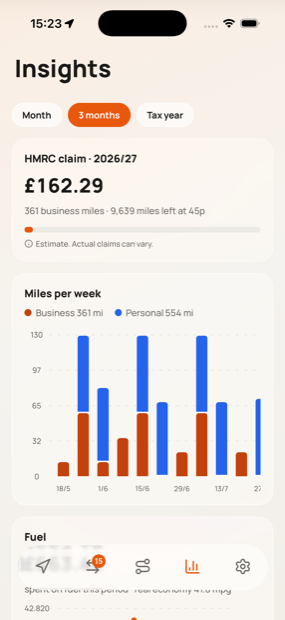
Take your business miles for the tax year. Multiply by the approved rate, banded at 10,000. That is the approved amount. Subtract everything your employer actually paid you per mile. The remainder is what you can claim relief on.
The car allowance itself does not enter this calculation at all. It is salary, it has already been taxed, and it is not a mileage payment. Deducting it from the approved amount, which people do, produces a much smaller number and often a nil claim.
| Car allowance | Mileage payment | |
|---|---|---|
| Paid because | You must have a car | You drove on business |
| Varies with miles | No | Yes |
| Taxed | Yes, as pay | No, at or below the approved rate |
| Counts against your approved amount | No | Yes |
| Employer must provide | No | No |
The other half of the trap
The reverse error exists too, and it is worse.
If your employer pays above the approved rate per mile, the excess is taxable and should be reported. An employer paying 60p a mile is paying you 15p a mile of taxable income, whatever they call it. That is a smaller population of people, but the ones affected tend not to know.
Why this needs a log rather than an estimate
Everything above turns on one number: business miles actually driven, in the tax year, with the 10,000 threshold in the right place.
A car allowance arrives whether or not you record anything, which is precisely why people on allowances tend to keep the worst records. There is no monthly claim form forcing the issue, so the miles go unrecorded, and by April there is nothing to build a relief claim from except a guess. A guess is not a claim.
Sources
- Tax relief for employees: business mileage and fuel costs (HMRC)
- Expenses and benefits: business travel mileage, rules for tax (HMRC)
- Claim Income Tax relief for your employment expenses (P87) (HMRC)
- Travel, mileage and fuel rates and allowances (HMRC)
General information, not tax advice. Check anything that matters with HMRC or your accountant.