 Milesheet
What 80 costs you compared with 70
Drag rises with the square of speed, so the last ten miles an hour are the expensive ones. The arithmetic, and what it is worth on a real journey.

Most cars are at their most efficient somewhere between 45 and 60 mph. Above that, economy falls away, and it falls away faster the faster you go.
Why speed costs more than it looks
At motorway speeds, most of the engine's work is pushing air out of the way. Aerodynamic drag rises with the square of speed, and the power needed to overcome it rises with the cube.
The practical upshot: going from 60 to 70 costs you something. Going from 70 to 80 costs you noticeably more than that, even though it is the same ten miles an hour.
Typical real-world figures put the drop at roughly 10-15% from 70 to 80, on top of a similar drop from 60 to 70. A car returning 50 mpg at a steady 60 might see low 40s at 70 and high 30s at 80.
What it is worth on a real trip
Take a 200-mile motorway run in a car doing 45 mpg at 70.
- At 70 mph: about 20 litres. At 145p, roughly £29. Journey time around 2h 51m.
- At 80 mph: maybe 40 mpg, so about 22.7 litres, roughly £33. Journey time around 2h 30m.
So the faster run costs about £4 more and saves about twenty minutes, before considering that the twenty minutes rarely survives contact with roadworks, and that the faster you were going the more the licence costs if it goes wrong.
Whether £4 for twenty minutes is a good trade is a personal question. The point is that it is a knowable one.
The numbers on a 200-mile run
A car returning 45 mpg at a steady 70, fuel at 145p:
| Speed | Approx. MPG | Litres | Fuel cost | Journey time | Time saved | Cost per minute saved |
|---|---|---|---|---|---|---|
| 60 mph | 52 | 17.5 | £25.35 | 3h 20m | n/a | n/a |
| 70 mph | 45 | 20.2 | £29.30 | 2h 51m | 29 min | 14p |
| 80 mph | 40 | 22.7 | £32.95 | 2h 30m | 50 min | 15p |
| 85 mph | 37 | 24.6 | £35.60 | 2h 21m | 59 min | 17p |
Two things fall out of this. The cost per minute saved is remarkably flat, so the "is it worth it" question is really about whether the minutes matter to you. And the totals are small enough that speed is rarely where a fuel problem actually lives.
The things that cost more than speed
If you actually want to move the needle, these are bigger levers than the last ten miles an hour:
- A roof box or bars left on all year. A box can cost 10-20% at motorway speed. Bars alone are not free either. Take them off.
- Under-inflated tyres. Rolling resistance rises as pressure falls, and pressure falls in winter whether you check it or not.
- Carrying weight you do not need. Less dramatic than the internet claims, but real if the boot is a permanent storeroom.
- Stop-start town driving. No motorway speed is as expensive per mile as accelerating away from lights repeatedly.
Measure rather than guess
All of the above is averages, and your car is not an average. The only way to know what any of it is worth to you is to log fill-ups with the odometer and watch what your MPG actually does across tanks.
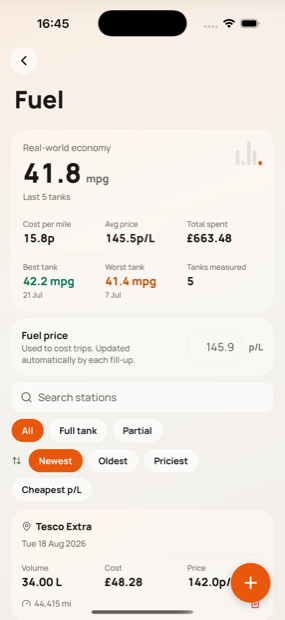
Milesheet works out real economy between full tanks and charts it, so a change of habit, or a roof box coming off, shows up as a shape rather than a feeling.