 Milesheet
The 24-month rule, in plain English
When a temporary workplace quietly becomes a permanent one, why the clock can start before you notice, and what it costs when it does.

Travel to a temporary workplace is claimable. Travel to a permanent workplace is ordinary commuting and is not. The 24-month rule is how HMRC decides which one you are looking at, and it catches people out because it works on expectation rather than hindsight.
The rule
A workplace stops being temporary when you have attended it, or expect to attend it, for more than 24 months, and your attendance is for a significant part of your working time.
Both halves matter. Two years on a site three days a week is caught. Two years popping in once a quarter is not.
The part that surprises people
It is not "you can claim for the first 24 months and then stop". The test is about expectation.
If you take an assignment that everyone knows from day one will run for three years, the workplace is permanent from the first day. There is no 24 months of allowable travel followed by a cut-off. It was never temporary.
Conversely, if a six-month contract keeps being extended and at month 20 it becomes clear it will run past two years, the travel stops being claimable from the point your expectation changed, not from month 24.
That is the trap. The clock is not counting your journeys. It is measuring what you reasonably expected.
"Significant part of your working time"
HMRC does not fix a percentage in the legislation, but 40% of your working time is the figure used in practice as the rule of thumb. Below that, a workplace can remain temporary even beyond 24 months.
This is what makes the occasional-visit case genuinely different from the four-days-a-week case, and why two people on the same contract can get different answers.
Four scenarios, worked through
| Situation | Temporary? | Travel claimable |
|---|---|---|
| 9-month contract, expected 9 months | Yes | Throughout |
| 3-year contract, known on day one | No | None, from day one |
| 12-month contract, extended at month 10 to 30 months | Yes, then no | Until month 10 only |
| 30-month engagement, attending one day a fortnight | Yes | Throughout, below the "significant part" test |
The third row is the one that costs people money, because nothing visible changes on the day the answer does. The clock is not counting your journeys; it is tracking what you reasonably expected.
What it is worth, in money
A 30-mile each-way commute to a site, four days a week, 46 weeks a year:
| Miles | Approved amount | |
|---|---|---|
| Per day | 60 | £27.00 |
| Per week (4 days) | 240 | £108.00 |
| Per year | 11,040 | £4,730 (banded) |
Claiming that where the workplace was in fact permanent is an error worth thousands, repeated annually. Failing to claim it where the workplace genuinely was temporary is the same number, left behind.
Why it is worth getting right
The sums are not small. Someone driving 30 miles each way to a site four days a week covers roughly 12,000 business miles a year. At the approved rates, that is a little over £5,000 of allowance. Claiming it when the workplace was in fact permanent is the kind of error that gets expensive if it is repeated across several years.
Getting it wrong the other way, assuming a site is permanent when it qualified as temporary, is just money left behind.
What to do about it
Keep the record either way. A journey you did not log cannot be claimed later if it turns out you were entitled, and a journey you logged but did not claim costs you nothing.
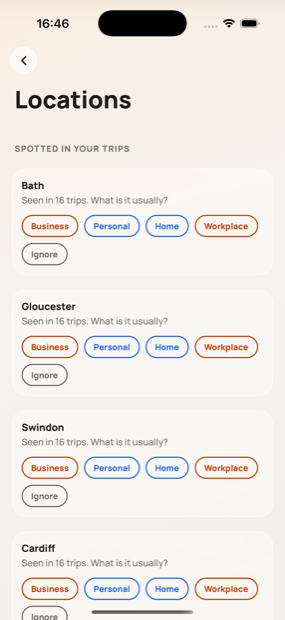
In Milesheet, tag a genuinely permanent workplace as Workplace and your house as Home: those journeys are then recognised as ordinary commuting and kept out of your claim automatically, while staying in your records. Tag a temporary site as Business instead, and it counts.
If the status of a site changes, an extension lands, the expectation shifts, change the tag from that date. The history stays intact and the claim adjusts.
Sources
- 490: Employee travel, a tax and NICs guide (HMRC)
- Employment Income Manual EIM31815: temporary workplace (HMRC)
- Claim tax relief for your job expenses: vehicles you use for work (HMRC)
General information for UK drivers, not tax advice. The 24-month rule turns on the facts of your case: if a site is close to the line, take proper advice.