 Milesheet
If you work from home, where does business travel start?
Whether your house counts as a workplace, when the drive to the office becomes claimable, and why hybrid working makes this harder rather than easier.


Hybrid working broke a rule that used to be simple. When everyone went to an office five days a week, home was home and the office was the permanent workplace. Now the line moves, and a lot of people are guessing.
The default answer
Your home is not automatically a workplace just because you work in it. HMRC's starting position is that where you live is a personal choice, and travel from it to your employer's premises is ordinary commuting, not claimable, whether you go five days a week or one.
That is the answer most hybrid workers do not want, and it is the answer that applies to most of them.
When home genuinely is a workplace
It can be, but the bar is meaningful. Broadly, the duties you perform at home must be substantive, real work, not just admin you could have done anywhere, and there must be an objective requirement to do them at home, rather than a personal preference or an employer being relaxed about it.
"My employer lets me work from home three days a week" does not clear it. "There is no office within a hundred miles and my role requires a base" is much closer.
If home does qualify as a workplace, travel from there to another workplace is business travel, and the picture changes considerably.
The trap in the middle
The most common hybrid mistake is treating office days as claimable because they are occasional. Frequency is not the test. A permanent workplace visited once a fortnight is still a permanent workplace, and the drive to it is still commuting.
Equally, people under-claim: a drive from home straight to a client, on a day you would otherwise have been at home, is business travel and often goes unrecorded because it did not feel like a "work trip".
The hybrid cases, resolved
| Journey | Claimable? |
|---|---|
| Home → office, 5 days a week | No, commuting |
| Home → office, once a fortnight | No, still a permanent workplace |
| Home → client, on a home-working day | Yes |
| Home → office → client → home | Leg 1 no, legs 2 and 3 yes |
| Home → temporary project site | Yes, subject to the 24-month rule |
| Home → coworking space the employer pays for | Depends whether it is a permanent workplace |
| Home → office on a day you were not required in | No, frequency is not the test |
Triangular journeys
Home → office → client → home is three legs and they are not all the same.
- Home to office: commuting, not claimable
- Office to client: business travel, claimable
- Client to home: usually claimable, though if you detour somewhere personal on the way, that part is not
The practical answer is to record all of it and classify each leg for what it was, rather than deciding at the end of the month that the whole day was or was not "business".
Why the record helps here more than anywhere
This is precisely the area where a claim gets challenged, because the facts vary person to person and month to month. A contemporaneous log, recorded on the day, not reconstructed in April, is the difference between a defensible position and an argument.
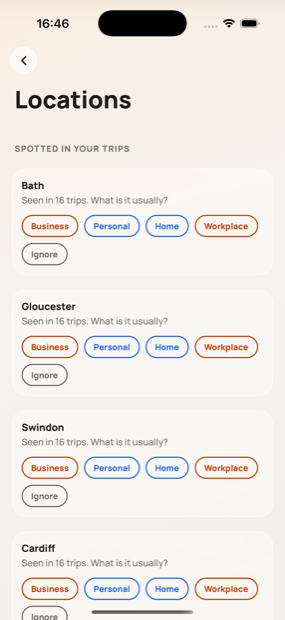
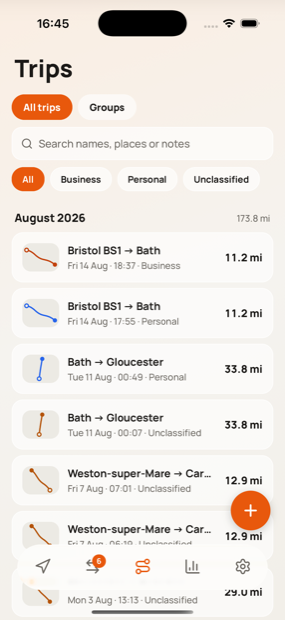
Milesheet records each leg separately, so a day like the one above arrives as three journeys you can sort individually. Tag home as Home and the office as Workplace and the commuting legs are recognised and kept out of the claim automatically, while still sitting in your records where you can see them.
Sources
- 490: Employee travel, a tax and NICs guide (HMRC)
- Employment Income Manual EIM31815: temporary workplace (HMRC)
- Claim tax relief for your job expenses: vehicles you use for work (HMRC)
General information for UK drivers, not tax advice. Whether a home qualifies as a workplace is fact-specific: if you are relying on it, get it confirmed.