 Milesheet
What actually counts as a business mile?
The commute trap, the temporary workplace rule, and the everyday journeys people wrongly leave off their claim.

Most underclaimed mileage is not fraud in reverse, it is uncertainty. People are not sure which drives count, so they leave off the ones they could have claimed and add up the rest badly. Here is the line, in plain terms.
The commute does not count
Travel between your home and your permanent workplace is ordinary commuting, and it is never business travel. It does not matter that you left at six in the morning, or that you carried equipment, or that you went in on a Sunday.
A permanent workplace is somewhere you attend regularly for your work, in a way that is not temporary or one-off.
Temporary workplaces do count
Travel to a temporary workplace is business travel, and this is where the claims live. A workplace is temporary if you go there to do a task of limited duration, or for a temporary purpose.
The catch is the 24-month rule. If you expect to spend more than 40% of your working time at a site for more than 24 months, it stops being temporary. Importantly, it stops the moment you expect that to be true, not when the 24 months elapse. A contract extension can retrospectively change what you should have been claiming.
Journeys that usually count
- Driving to a client, a customer, a supplier or a site
- Travelling between two workplaces on the same day
- Going from home directly to a temporary site, if you are not going via the office
- Driving to a conference, training course or trade show your work requires
- A trip to the bank, the post office or the wholesaler for the business, if you are self-employed
Journeys that usually do not
- Home to your usual office, in any circumstances
- A detour for something personal, for the personal part of the distance
- Taking a colleague home after work, unless it is part of a business journey
- Driving somewhere purely social, even with people from work
The awkward middle: home as a workplace
If you genuinely work from home as a requirement of the job, journeys from home to a client can be business travel. But HMRC looks carefully at whether home is a workplace by objective necessity or just where you choose to sit. Working from home three days a week by preference does not turn your Thursday commute into a business mile.
Why the recording matters more than the rules
Two people can drive identical routes and only one of them can claim, because only one of them can say what the journey was for. A date, a start, an end, a distance and a reason is what turns a drive into a claim. Reconstructing that from memory in April is where accuracy goes to die.
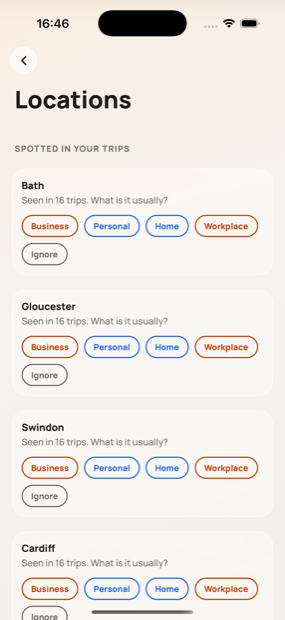
That is why Milesheet asks one question and only one: business or personal. It already knows the date, the route, the distance and how long you were stopped. You just tell it what the drive was for, ideally on the same day, when you can still remember.
The quick reference
| Journey | Claimable? | Why |
|---|---|---|
| Home → permanent workplace | No | Ordinary commuting |
| Home → temporary workplace | Yes | Travel to a temporary workplace |
| Home → client, direct | Yes | Business travel |
| Office → client → office | Yes | Travel in the performance of duties |
| Office → client → home | Usually yes | Unless you detour somewhere personal |
| Home → office → client | Mixed | First leg commuting, second leg business |
| Permanent workplace → second permanent workplace, same employer | Yes | Travel between workplaces |
| Home → workplace of a second, unconnected employer | No | Commuting for that employment |
| Home → workplace of a connected employer | Often yes | Travel between connected employments |
| Detour to the shops on the way back from a client | Partly | The business element only |
| Driving to a training course required by the job | Usually yes | If the workplace is temporary |
The three tests, in order
Work through these and most journeys resolve:
- Is this a workplace you attend, or somewhere you are going for work? A client visit is straightforwardly business travel.
- If it is a workplace, is it permanent or temporary? Apply the 24-month rule, remembering it turns on what you expect, not what has happened so far.
- If it is permanent, is the journey between two workplaces rather than from home? Workplace to workplace is business travel; home to workplace is not.
What a defensible record looks like
| Field | Example | Why it matters |
|---|---|---|
| Date | 14 August 2026 | Ties to your calendar and invoices |
| From | Home | Establishes the journey type |
| To | Harrogate, Acme Ltd | Names the workplace, not just a town |
| Purpose | Site survey | The business character, in a few words |
| Distance | 18.4 mi | Not a round number, because real drives are not round |
| Vehicle | Van (AB26 CDE) | Keeps multi-vehicle totals apart |
The purpose column is the one people leave out and the one that turns a list of distances into a record. "Site survey" takes three seconds and answers the question HMRC would actually ask.
Sources
- 490: Employee travel, a tax and NICs guide (HMRC)
- Employment Income Manual EIM31815: temporary workplace (HMRC)
- Claim tax relief for your job expenses: vehicles you use for work (HMRC)
- Business travel mileage for employees' own vehicles (HMRC)
General information for UK drivers, not tax advice. If your situation is unusual, particularly around temporary workplaces, take proper advice.