 Milesheet
Mileage rate or actual costs: which is worth more to you
Self-employed drivers get a choice, it is effectively permanent for that vehicle, and the right answer depends on how much the car cost and how far you drive.


If you are self-employed, you can deduct the cost of business driving one of two ways. Choosing well is worth real money, and the choice is stickier than most people realise.
The two options
Simplified expenses (the mileage rate). Claim a flat 55p a mile for the first 10,000 business miles in the tax year and 25p after that. That figure is meant to cover everything: fuel, insurance, servicing, repairs, road tax, depreciation. You claim nothing else for the vehicle.
Actual costs. Work out what the vehicle really costs you across the year, then claim the business proportion of it. You also claim capital allowances on the purchase price. This means keeping receipts for everything and knowing your business-use percentage.
The rule that catches people
Once you have used the mileage rate for a particular vehicle, you must keep using it for that vehicle for as long as you own it. You cannot claim 55p a mile for three years and then switch to actual costs when the car needs a new gearbox.
It also runs the other way: if you claim capital allowances on a vehicle, the mileage rate is closed to you for that vehicle.
So the decision is made once, early, and lives with the car.
The quick test
| Your situation | Likely better |
|---|---|
| Cheap or already-owned car, high business mileage | Mileage rate |
| Economical car, moderate mileage | Mileage rate |
| Expensive vehicle, high business-use percentage | Actual costs |
| Thirsty van working hard | Actual costs |
| Low business mileage, expensive car | Actual costs |
| You would rather not keep receipts | Mileage rate |
Which usually wins
The mileage rate tends to win when:
- The car was cheap, or was already yours
- You drive a lot of business miles in it
- It is economical, so 55p comfortably exceeds what the mile actually cost
- You would rather not keep every receipt
Actual costs tend to win when:
- The vehicle was expensive, so the capital allowances are substantial
- Business use is a high proportion of total use
- Running costs are genuinely high: a van, something thirsty, something old and needy
- Your annual business mileage is modest, so the flat rate does not add up to much
The rough test: estimate your business miles for the year, multiply by the rate, and compare it against your real annual running costs times your business-use percentage. If the answer is close, the mileage rate is usually the better deal simply because it takes an afternoon less to administer.
The two methods side by side
| Mileage rate | Actual costs | |
|---|---|---|
| What you claim | 55p / 25p a mile | Business share of real costs |
| Capital allowances | No | Yes, on the purchase |
| Receipts needed | Mileage log only | Everything, all year |
| Business-use % needed | No | Yes, and defensible |
| Can you switch later? | No, not for that vehicle | No |
| Best for | Cheap, economical, high mileage | Expensive, thirsty, high business use |
A worked comparison
A van bought for £18,000, doing 8,000 business miles out of 12,000 total (67% business):
| Mileage rate | Actual costs | |
|---|---|---|
| Fuel, servicing, tyres, insurance, tax (£4,200 × 67%) | n/a | £2,814 |
| Capital allowances, first year (illustrative) | n/a | £3,240 |
| 8,000 miles at 55p | £4,400 | n/a |
| Year one total | £3,600 | £6,054 |
| Year four total (allowances largely spent) | £3,600 | ~£2,900 |
Actual costs win early, because of the capital allowances. The mileage rate wins later, because it does not decline. Since the choice is locked per vehicle, the question is which side of that crossover you expect to spend most of the vehicle's life on.
Figures are illustrative. Capital allowance treatment depends on the vehicle and your circumstances, which is exactly why this one is worth an accountant's hour.
You still need the mileage log either way
This is the part people miss. Choosing actual costs does not free you from recording journeys. It makes the record more important, because your business-use percentage has to be justified from somewhere. "About 60%" is not a figure HMRC can check, and neither can you.
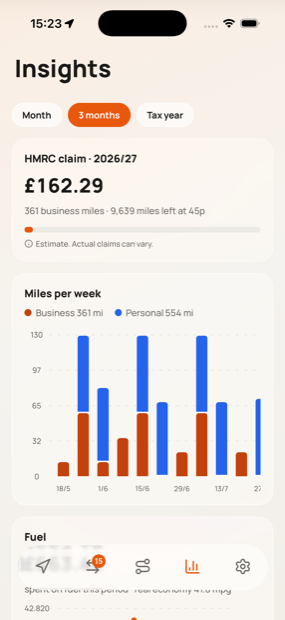
Whichever route you take, the underlying evidence is the same: date, from, to, purpose, distance. That is what Milesheet records, and why the log is worth keeping before you have decided which method you are using.
Sources
- Expenses if you're self-employed: vehicles (HMRC)
- Simplified expenses checker (HMRC)
- Travel, mileage and fuel rates and allowances (HMRC)
- Self Assessment: keeping your records (HMRC)
General information for UK drivers, not tax advice. The choice between methods has long-term consequences: worth an hour of an accountant's time before you commit.